Showing posts with label Paul Mc Guinness. Show all posts

Wednesday, March 22, 2017

U2 and the question which won’t go away


An interview with their ex-manager Paul McGuinness is a reminder of new realities in the ticket selling business


I’d kind of forgotten about the fact that U2 were blanking me until I came across a transcript of a recent interview with Paul McGuinness. The band’s ex-manager spoke at length to former Dire Straits manager Ed Bicknell about the ins and outs of the music business at the International Live Music Conference (ILMC) in London the other week.

One of the many issues covered in what sounds like an entertaining session at the annual get-together for agents and promoters was ticket selling and touting. It was the mention of allocations for fan clubs which reminded me that I’m still waiting for the band to answer a simple question about the number of tickets sold in the fanclub presale process for their upcoming Croke Park show.

I’ve now asked U2′s Irish spokesperson for this information three times and I’ve even tweeted the band (#journorequest) and am still none the wiser as to the answer or, indeed, why the band are not answering the question. I was kind of hoping that one of those fanboy hacks that the band only talk to these days might do a solid for me, but they’re far too worried about access to dare ask a tough question.

But McGuinness was certainly happy to comment about fan club allocations and he uses the word “unfairness” to describe the situation around such allocations. “I know there’s a sense of unfairness in the air, he told Bicknell. “People go online to buy a ticket and think they have an equal chance of getting that ticket. If two minutes later they see the same tickets being scalped, it’s a miserable feeling. It has to be acknowledged that certain promoters, certain managers and certain acts connive at this. You could say it’s unfair that members of the U2 fan club get a two day jump on the rest of the public — knowing as they do that many members of U2.com are bot operators.

The fact that McGuinness acknowledges that many members of U2.com are touting their tickets is, as far as I can work out, one of the first times anyone on that side of the house has acknowledged this dirty little secret. It stands to reason that touts are making merry with fan club memberships. They can make back the cost of the sign-up fee many times over by upselling the tickets on sites like Seatwave and Get Me In. If a tout gets fan club memberships for a bunch of people, he or she suddenly has easy access to possibly hundreds of tickets for a sellout show. Profits ahoy.

The question now is just how many tickets go on sale to the public in these situations. Take U2′s Croke Park show, for example, which sold out in about six minutes when tickets went on general sale. You’ve got the fanclub allocation – while I’ve yet to hear from the band’s rep about this despite several requests as outlined above, I’ve heard figures from inside sources indicating “tens of thousands” – and you’ve got the allocation for sponsors, venue holds and the like. Add those figures up, take the total away from the venue capacity (78,000 per the band’s rep) and what are you left with? 20,000? 30,000? 14,500? All that fuss and buzz and hype and anticipation for a sale of a quarter or less of the stadium? No wonder people were fuming that they couldn’t get their hands on tickets.

All of this part of a much bigger issue, which McGuiness also acknowledged. “I don’t really know what to do about it. There’s good scalping and bad scalping. If you sell four tickets at face value to a college student at $100 each and when the gig takes place six months later the market value for that ticket is $300. Who is going to say to that college student, “You’re not entitled to sell that ticket and make a profit?” It’s very hard to address fairly. It’s a market that defies regulation. I have never seen a comprehensive proposal to deal with this fairly and where do you stop? Will it then extend to Wimbledon and football matches? Are you going to clean up the whole of the ticket economy?”

Regular readers will know that ticket touting is something covered at length on OTR – you’ll also find a great selection of recent pieces put together here by Matty Karas at MusicREDEF – and it is a complex area, especially now that various government agencies and bodies (and attention-seeking TDs) have got involved.

However, it is also an area where it would be very easy to overlook the involvement of the some key parties and that includes the artists. Remember that it’s the artist who has the final say in all of this, especially when it comes to who reps them. After all, as mentioned in that earlier U2 piece, there are issues when “the same corporate entity is promoting the U2 tour, managing the band, flogging the tickets and operating two of the biggest secondary ticketing markets“. 

Tuesday, November 25, 2014

U2‬'s 5th Member: Paul McGuinness


He's the man Bono often called the 'fifth' member. 
Music legend Paul McGuinness managed U2 into international super-stardom for over 35 years and he joins us live from the ARIA masterclass.

Wednesday, September 10, 2014

Paul McGuinness on the new U2 album and 2015 tour plans


“I thought the exercise they mounted yesterday was absolutely spectacular and a huge success; a new way of distributing music to the world,” he proffers. “I think it stunned everyone. I’m just working through the worldwide press and the two things to come out of that are, first of all, astonishment that they were able to do it and do it secretly, but also how good the record is. There seems to be near unanimity on that.

“I heard the complete album a few days ago and it’s brilliant. It’s U2 yet again doing their best work late into their career.”

Paul goes on to debunk the idea that the band are taking a financial hit on Songs Of Innocence.

“The way they have released it is obviously extraordinary,” he resumes. “I think you have to read the detail; Bono has an interview today in Time magazine and he points out that it’s not free. He’s absolutely opposed to free. It may be free to the consumer but I can assure you that Apple will haves paid a very high price to U2 and Universal Records for the right to do that.”

As for live dates, Paul reckons U2 fans are in for an exciting 2015.

“I think you can expect a major tour starting next summer that will in every way be what people expect of U2 - groundbreaking, unique and world-beating.”

 http://www.hotpress.com/

Thursday, April 3, 2014

'Starting From Scratch'


North Side Story, the definitive account of the emergence of U2 in Dublin, is a limited edition publication which comes with a U2.com subscription.  Among the scores of revealing interviews is one with Paul McGuinness and in this extract he recalls his earliest days in the music business - and first meeting U2. 

'I first got involved in the music business managing Spud, who I suppose were a kind of a poor man’s Horslips. This was in the mid ‘70s. They didn’t write their own songs. They did bluegrass and a bit of trad, which was never going to be easy to sell internationally. Initially they didn’t have a drummer and that meant that they were only able to do cabaret gigs and pub gigs – so there was no future in that. And so when I started to manage them I encouraged them to get a drummer, which was pretty obvious really. But it meant that they could do concerts and it helped me to get them gigs outside Ireland.

One important thing I learned managing Spud was this. They were about the same age as I was. They were in their mid twenties and they had started to get married and have kids and so their attitude to touring was pretty limited and lacking in ambition. They didn’t want to spend too much time on the road. They needed to get home and be with their families. And so I realised that at 25 or 26 or whatever, they were too old to make it. It needed a level of commitment that they couldn’t give. One place where we did get a bit of traction with Spud was Sweden. That was a little bit to do with the exchange rates, so that you could actually go there and make a bit of money. And so for a while I became a sort of agent, booking tours in Sweden. I also managed the Thom Moore band, Midnight Well, but I knew they were never going to be a really big band internationally. So I was always looking for something else, ideally a baby band, with youth on their side, that you could start with from scratch and aim to take over the world with.

I always felt that the Horslips model was a good one. I knew the guys in the band and their manager Michael Deeney was a friend of mine. What they did in business terms was very significant. They based themselves in Ireland and had their own record label – and so they controlled the recordings and they licensed the records for release outside Ireland. So they showed that a band could be based in Ireland and run their operation from here, which was what we eventually did with U2. When the punk thing started to happen in the UK, The Boomtown Rats came along and they were very determined to get out of Ireland as quickly as they could. They were very aggressive in their approach to getting a deal. They were very good at generating publicity and at selling themselves, so there was a lot to be learnt from them. So I was observing the business and how it operates – and doing things like reading Billboard magazine. And all the time, I was on the lookout for a young band that
would have the potential to become internationally successful.

U2, of course, were very young when they started out. They formed at Mount Temple which was a very liberal school in terms of its music policy. The music teacher there Albert Bradshaw was a remarkable man and they actually encouraged bands to play. The most important thing, I would say, was that they allowed the band to rehearse there, which was of huge significance, because a place to rehearse is the hardest thing for a young band to find. They won that talent competition in Limerick – at which Jackie Hayden was one of the judges. And the prize included studio time to do a demo, which they recorded in Keystone Studios. So they had begun to make things happen.

Adam had been managing the band up to that point and he got Bill Graham of Hot Press along to one of their rehearsals, I’m not sure where. They played some songs, which Bill immediately spotted were Ramones songs, which was a bit embarrassing! But he was impressed all the same. It is well documented that it was Bill who subsequently introduced me to the band and told me that I was going to manage them. The first time I saw them was in the Project Arts Centre, in June of 1978, supporting a band called The Gamblers – who as it happens were managed by my 16 year old sister Katy. I didn’t like to say it to her, but U2 were clearly the better band.

What struck me most about U2 that night was that they had presence. They weren’t shy in the way a lot of Irish bands were shy. The Radiators From Space had come through a little bit earlier – they were sponsored to an extent by Eamon Carr of Horslips. But they were rather shy and quiet. U2 were very different in that respect. Bono was always at the front of the stage, trying to engage with the crowd, getting them to look into his eyes. And even if they were a bit unsophisticated at that point, they had an energy and a confidence about them. They looked like a proper band on stage. And when I spoke to them, I could see immediately that they were smart. They were ambitious. And they knew that you had to work hard if you were going to become successful. And they were prepared to do that, in a way that a lot of other bands weren’t.  

They were also interested in every aspect of the process. They were interested in photography. They were interested in design. And so they were good at finding people who could become collaborators. Steve Averill, who of course had given them their name,  was working with them. And though Bill Graham wasn’t a collaborator as such, he was a very big influence at that stage. So they were very intelligent and tuned in. They wanted to know how everything worked. I started to manage them that night – at least I told them that night that I would and we spent a few months skirting around one another trying to work out who was going to do what and whether we were on the same wavelength. And, it turned out, we were.'

Commissioned from the Hot Press team in Ireland, North Side Story  covers six formative years from 1978 to 1983, from the first single, 'U23', to the live album, Under A Blood Red Sky.  Running to 274 pages, this heavyweight book of rare photos, original interviews, diaries, letters and profiles comes with 'North & South Of The River, Wandering In U2's Dublin', a poster-size map charting U2's Dublin. 


http://www.u2.com/

Monday, February 10, 2014

Paul McGuinness on Life After U2, Midem, Calling Out Tech Companies (Q&A)

Paul McGuinness on Life After U2, Midem, Calling Out Tech Companies (Q&A)


Paul McGuinness, legendary U2 manager and winner of this year's Billboard Industry Icon Award, does not mince words. Not only did he deliver one of Midem's best speeches at the award's ceremony, but he also gave a fantastic follow-up interview discussing life after U2, his thoughts on major tech firms, the Midem conference and why he's not afraid to jump into the fray. 
Billboard: Congratulations on being named Billboard's 2014 Industry Icon
Paul McGuinness: I'm grateful, honored, thank you.
You've always kind of shied away from the limelight, how do you feel about doing events like this. 
When people come to work for me one of the things that is part of their jobs is to read the trades. And that always means Billboard, and Music Week as well, and I expect them to know what's in there. And find the time each week to read Billboard, not just weekly but daily actually there's important stuff in there.
Do you look at Billboard.biz?
Yeah of course.

Do you find it hard to take a step back after being in the music industry for so long? Is it a hard to transition to make or are you looking forward to it?
I've been looking forward to it. There are other parts show biz that i'm interested in as well. I'm one of the owners of the film studios in Ireland. And a few years ago I was involved in setting up Ireland's TV3 which i'm not involved in any longer but that was exciting. I certainly intend to remain involved in the entertainment just not managing artists any longer. That's the big change, I'm not going to do that anymore.
Was running the record-setting U2 360 tour the hardest you've ever worked as a manager
Oh yeah, it was a giant undertaking. II think it was about 110 shows and as i said we grossed three-quarters of a billion dollars. So the sums of money were staggering. To set it up was staggering. But then the rewards were enormous.
Did you get burned out working on it? Didn't it run for 2-3 years?
Well it ran for longer than we intended because Bono had a serious back injury so we had to postpone. So everything was bigger. So were setting world records. There was  even a record-setting insurance claim.
How were your stress levels through that?
It was a strain to hear every morning that we had spent x million of dollars and that rate of burn, that's a strain. But Live Nation make it very easy. We have very strong relationship with Arthur [Fogel], it would be impossible without them. The last tour we did without a worldwide promoter was in 1991. When the band took the risk, I didn't really want to take the risk after that and neither did the band.
It was interesting what you said in your acceptance speech about you and the band "infiltrating" a major label at Universal and effectively using the mechanisms to your own benefit and also how you were able to get your masters back.
We got them back, they wanted to extend the deal and we had to claw them back. We said you can extend the deal but we're licensing them to you. We were having enough success to make that work for both parties.
When was your first Midem
I want to say early-80s, about 1983 or 1984 maybe?
And what was it like then?
It was much more crowded. And quite wild late night. It was pre-digital so everyone was making deals in the corridors.  And the record companies in the mid-80s they were just starting the CD boom and there was a lot of let's just say excess. Overall, the music industry prepared for the digital age very badly. There's no doubt about that. All this stuff was coming, you could sense it but the label bosses were very short sighted—anyone who thought past the holiday season was regarded as a strategic thinker.
Do you feel Midem is still worth your while?
Yes I do. Over the years the conference part has become much more significant than it used to be. It used to be really a side part and now there's a genuine exchange of policy ideas and it's very formative and the debate is very often conducted here. People take it very seriously intellectually.  The trade fair has kind of diminished because everyone's doing it online rather than on the street. It used to be much more of a bazaar.
Power Music Biz Trio: (From left) Beggars Group chairman Martin Mills, Billboard Industry Icon Award honoree Paul McGuinness and venerated music man Seymour Stein at Billboard's 2014 Industry Icon brunch at the Carlton Hotel in Cannes, France.Desjardins/Image & Co.

Monday, January 20, 2014

Billboard's 2014 Industry Icon: Paul McGuinness on 35 Years Guiding 'The Biggest Band in the World'

Billboard's 2014 Industry Icon: Paul McGuinness on 35 Years Guiding 'The Biggest Band in the World' (Q&A)


The following extended Q&A with U2's long-time manager Paul McGuinness is from the new issue of Billboard.

Few managers are so closely associated with one act as Paul McGuinness has been with U2, a group he took from a fledgling band of dubious musicianship playing Dublin bars to where it is widely considered the biggest group in the world.

News broke late last year that McGuinness would step back from day-to-day duties for U2 after more than 35 years, handing the reins to Madonna manager Guy Oseary, as the band’s management shifts from McGuinness’ Principle Management to the management division of Live Nation, with whom U2 signed a 12-year touring/merchandising/e-commerce pact in 2008.


In a statement, U2 said, in part, “Paul has saved us from ourselves many times over and we would not be U2 without him,” describing his ongoing role as “mentor in chief.”

The move represents a monumental change for McGuinness, who has devoted more than half of his life to guiding U2. While he has directed countless significant career moves along the way, perhaps the most visionary was realizing the potential of a band he recalls “weren’t very good at all” when he was first introduced to the group by influential Irish music writer Bill Graham -- though McGuinness adds that his own lack of musical sophistication didn’t make the band’s lack of chops an issue.

But McGuinness did have the vision to recognize U2’s onstage alchemy -- an intense connection between band and audience -- and unlimited potential. The fiery ambition and creativity of both band and manager led to a career unlike any in pop history.

In recognition of his lifelong achievements and vision in moving the music industry forward, McGuinness will be the recipient of the 2014 Billboard Industry Icon Award. The honor will be presented at MIDEM in Cannes on Feb. 2. The inaugural Industry Icon Award was presented in 2012 to Sire Records founder/CEO Seymour Stein and in 2013 the honor went to Beggars Group founder/chairman Martin Mills.

Born in post-war Germany in 1951, McGuinness’ father was an officer in the Royal Air Force from Liverpool and his mother a schoolteacher from County Kerry in Ireland. The global perspective of U2’s development came naturally to McGuinness, who grew up on RAF bases around the world in such places as Malta, Yemen and various parts of England, first coming to Ireland for boarding school in 1961.

Raised in a non-musical household, McGuinness still was drawn to a career in the arts. He directed plays and tried his hand at journalism at Dublin’s Trinity College. After a brief career in film production (including a notable stint in the cult classic “Zardoz” with Sean Connery), McGuinness shifted his focus to music, working with such obscure Irish bands as Spud before that fateful introduction to U2 in 1978.

In a revealing, wide-ranging interview, Billboard picks up the story there, at the beginning of a relationship that forever changed the history of music.

Billboard: What was your first impression of U2?

Paul McGuinness: They were pretty smart -- that was the first thing that was very clear. They were ambitious, they were interested in what was going on with other bands, and were very committed to performance. Bono particularly was down the front of the stage, looking for eye contact with the audience. Even at a young age, he was a very charismatic frontman.

What were some of your early wins in managing U2?

It was very hard to get a record deal. I thought they were so good, and it was so obvious that they would develop, that it surprised me greatly that pretty well every record company in London passed on them. We had some success getting A&R men to see them, but we had either bad luck, the shows weren’t very good or the A&R guys just didn’t see it. It took a surprisingly long time to get a deal, and in the end the deal we got from Island was the only one on offer.

We were actually very lucky to get signed by Island, because their culture suited us perfectly. There seemed to be a policy of letting the artist be in charge. I’m sure it wasn’t as simple as that, but there was respect for the artist. What I did not realize at the time was that it was very important to have [Island founder] Chris Blackwell’s involvement. He wasn’t very involved in the signing of the band. He became a big supporter later, but the people who really signed the band at Island Records were [Island A&R man] Nick Stewart, press officer Rob Partridge and [talent scout] Annie Rosebury.

Were such superlatives as “biggest band in the world” even in your head at that point?

The only reason I wanted to manage a band at all was because I wanted to manage a very big band. I certainly wasn’t doing it philanthropically.

U2’s first three albums were critically acclaimed but less than blockbusters, and during that time the band really developed its performance chops. Did you always consider the live thing as a critical part of a band’s career?

We always realized that there were two parallel careers: one live and one on record. We felt instinctively in the early days that it was important to be a great live band so that we were not dependent upon the success of the records. The first album ["Boy," 1980] was, as you say, critically well-received, but didn’t have any hits. The hits off that album came much later. The second album ["October," 1981] was recorded in a bit of a hurry and, looking back on it, quite weak. The third album ["War," 1983] was a No. 1 album in the U.K., and ’round about that time the live album we did at Red Rocks [in Colorado, "Under a Blood Red Sky"] and the accompanying film [“Live at Red Rocks”] really did a lot to break the band in all countries. "Unforgettable Fire" in 1985 went to No. 1 in most European countries and did respectably in the U.S.

It was then that we started to play in arenas in the U.S. We had built up a very strong live base in America. I believed that was very important, and in the early ’80s we would spend three months of every year in the U.S.

One of the most important connections we ever made was with [agents] Frank Barsalona and Barbara Skydel at Premier Talent, [who] really believed in the band. They could see that it was a great live act. I learned an awful lot just from talking with Frank. I used to sit in his office until late at night when everyone else had gone home, and Barbara was our responsible agent. They were both major forces in the success of the band.

In Europe and other territories outside North America we had an equally brilliant agent in Ian Flooks and his company Wasted Talent -- the hot agency in Europe when we started out. They picked up on U2 right at the beginning, and we did every date we ever did in Europe for either them or an agent in Ireland called Dave Kavanagh. And we worked with promoters like Leon Ramakers and Thomas Johanssen in Europe since day one, as well as Michael Coppel in Australia.

Working with agents was fundamental to the early success of U2. The band wanted to be good live, and they were prepared to put a lot of time and effort into touring, and so was I. We were not prepared to be the kind of routine visiting English punk band. I attended pretty well every show they ever did.


Which shows stand out?

Many of our great shows have been at Madison Square Garden. It’s a very special place for us, and New York was always a very important market for us because it was such a great live market. We used to play multiple nights at the Ritz [now Webster Hall], and the money we made off those dates would subsidize the rest of the tour.
New York had very weak radio in the early ’80s. There were [rock stations] WNEW and WPLJ, and neither of those stations played U2. We were supported by a station in Long Island called WLIR. Really, we broke New York through performance.

Saturday, December 7, 2013

Thanking Paul McGuinness


 'This week U2 finalised and signed a new management contract with Live Nation and Guy Oseary.  

The band now want to publicly thank Paul McGuinness for his extraordinary leadership, guidance and friendship over the last 35 years.  

Paul has saved us from ourselves many times over and we would not be U2 without him. 

Sometime soon, U2 will begin a new adventure around the world and we totally understand and respect Paul's desire to not run away with the circus – AGAIN. 

Perhaps more than any music management operation in history, Paul, alongside Trevor, Keryn and the team at Principle Management has always fought for our rights, for our music, for our fans and for the principles that we and he believe in. His central lesson was that if you cared for your "art", you must also "take care of business" as historically with rock and roll bands, the latter has undone the former.  

We are relieved he will remain on as the mentor-in-chief. 

We've known Guy for a long, long time, and we're excited that with Paul's blessing he's agreed to take us on. He is a brilliant man with a lot of energy, and knows he has got some big shoes to fill.'

Bono, Edge, Adam and Larry 


http://www.u2.com

Thursday, November 28, 2013

Management Shuffle Signals End of U2′s Beautiful Day

Paul McGuinness U2

Paul McGuinness could never break another hit act — and usually the mark of a great manager is the ability to do it more than once. That’s the downfall of the music business: the belief that suits count more than artists.

Credit McGuinness with building U2.

But now’s a good time to get out, because the band is at a crossroads. It took all the money out of the market with a multiyear stadium trek and, without a hit single, it will probably never be able to tour at this scale again.

Hits are what U2 is dependent upon if it wants to keep the mantle of the world’s greatest rock and roll band, which it stole from the Stones decades ago, even if Mick Jagger doesn’t know that.

But rock is dead. At least on Top-40 radio, where hits are made.

What’s a poor boy to do?

Become a venture capitalist, like Bono did with Roger McNamee and Elevation.

Or try and save the world, which Bono is also doing.

But if he wants to stay a relevant musician, that’s a much harder goal to achieve.

But he’s got Guy Oseary in his corner! Oseary becomes the manager of U2 with McGuinness’ sale of Principle Management to Live Nation.

To believe Oseary is a great manager is to think Metallica svengali Cliff Burnstein can front a band, and Irving Azoff can play in the NBA. What Oseary does best is get into the head of Madonna and make her believe he’s indispensable, which he’s not. Madge has had a series of managers since she broke through, even the aforementioned Mr. Burnstein, who helped her stay relevant with “Ray of Light.”

But Madonna’s relevant no more. It pains her, but athletes retire. And in music, the game changes. It’s less about age than fads and desire and other elements elder people just can’t keep up with, and oftentimes look bad trying to. If you’re not willing to admit your age, you’re gonna have a hard time in popular culture.

And so often music is youth culture.

And you can tour to your core, but as you age that core cannot fill stadiums — not usually.

If you know McGuinness, he’s a force of nature. Someone who’s all what he’s promoting, 24/7. It’s not easy to find someone like that, who lives and dies for you. He’s essentially Col. Parker, but with a fairer deal and a worldwide viewpoint.

In other words, no one’s gonna care as much.

So U2 has lost its rudder.

And although Live Nation’s Arthur Fogel is brilliant at what he does — one of the absolute best — U2’s problem is not touring financials so much as creative issues.

Music has always operated best when unrestricted. When those involved were free to reinvent the wheel at their leisure, to test limits, be offensive and charm us all at the same time.

Tying up with Live Nation is no different from selling out to Google or Microsoft. You’ll get paid, but you’ll lose control. Happens every day: The founders get frustrated and leave, and their products often go into decline.

But music is not a mere product. When done right, it’s not evanescent. It pricks our hearts and stimulates our brains and makes us believe life is worth living.

Bono once had that power. He’s sacrificed it. So goodbye ’80s rock. And goodbye ’80s pop, too. We’re in a new era where the most stimulating productions emanate from bedrooms, get traction on YouTube and are shared virally by the general public.

There’s business and there’s music. Business ain’t bad. But music’s in sad shape.

Because everybody’s looking to sell out.

http://variety.com

Saturday, November 16, 2013

U2 and Paul McGuinness: the end of the affair

When Paul McGuinness began managing U2, in 1978, they were playing in car parks. This week he announced he would no longer be the ‘fifth member’ of the most successful live band of all time. Why?

Him too: Paul McGuinness (back) with U2 at an Island Records party in 1980. Photograph: L Cohen/WireImage/Getty
 Paul McGuinness (back) with U2 at an Island Records party in 1980. Photograph: L Cohen/WireImage/Getty

It was music’s Alex Ferguson moment: the guiding hand of a high-achieving corporation standing down after a long and hugely successful tenure. The 35-year relationship between Paul McGuinness and U2, which saw the band go from playing from the back of a van in a Dublin car park to becoming the most successful live touring band of all time, ended rather mutely this week with McGuinness selling his Principle Management company to the concert promoter Live Nation.
As with Ferguson, the 62-year-old is moving upstairs, to become chairman of Principle. Day-to-day management is being taken over by Guy Oseary, who also manages Madonna.
McGuinness made a statement to the New York Times that suggested his age was a factor in the decision. “It could be seen as slightly poor etiquette for a manager to consider retiring before his artist has split, quit or died, but U2 have never subscribed to the rock ’n’ roll code of conduct. As I approach the musically relevant age of 64 I have resolved to take a less hands-on role as the band embark on the next cycle of their extraordinary career.”
Oseary has been in place for a few weeks. McGuinness told the band two years ago that he was considering standing down. After three and a half decades in the rock ’n’ roll trenches and with a new album and world tour ready to go next year, it’s entirely possible that McGuinness decided he had had enough of the long days that managing one of the world’s biggest bands entails.
It was a surprise to some that U2’s official website and Facebook and Twitter accounts had nothing to say about their manager’s departure once news broke on Wednesday that he was standing down.
By the time Weekend Review went to press yesterday the band had made no statement to the media in general, and neither they nor McGuinness had responded to questions from The Irish Times.
Some see the absence of a valedictory statement from the band as bad form. “McGuinness deserves better than this,” says one observer who has had close links with the band for many years. “The failure of the band to issue a statement has not gone unnoticed in the industry.”
This does not necessarily point to strained relations between U2 and their former manager. There has been no official confirmation of the deal by Live Nation, so the band might regard a statement as premature.
“Paul fought, fought and fought again for the band,” says one person who has worked with McGuinness and knows him well personally. “He would be the one up early and still at work late at night, arguing with local police chiefs and mayors about stage times and curfews. He was more than loyal, and he literally kept the band together at times. He’s an absolute gentleman who will defend U2 to the death.”

All one needs to know about what McGuinness did for U2 is to consider that Bruce Springsteen refers to his manager, Jon Landau, as the American Paul McGuinness.
In May 1978 a new band then known as The Hype were playing at Project Arts Centre in Dublin. Even then they had ideas about themselves. Paul Hewson, David Evans, Larry Mullen jnr and Adam Clayton figured they needed a manager to get them a record deal.
McGuinness was in the audience that night and was impressed by the inchoate new-wave noise he heard from the stage. Taking them to the Granary pub next door, where the members of U2 were too young to be served alcohol, he immediately impressed the ambitious, wide-eyed northsiders by telling them how to handle all the money that would inevitably flow in once they had an album in the shops.
He talked sagely about how The Beatles and The Rolling Stones had run into problems by not sharing their income equally between the band’s songwriting and nonsongwriting members. He persuaded them to share everything. “It has stood them in very good stead, because it backs up the democracy of a decision if everyone’s making the same amount of money,” he later said.
He also negotiated an equal 20 per cent of U2’s income for himself. For a long time he was, very unusually, paid as if he were part of the band. “This was reviewed later on. There should always be a division between client and manager,” he has said.


Friday, November 15, 2013

U2: what will $30m management deal mean?

U2 are being taken over by Live Nation and Madonna's manager in a $30 million deal. Will this lead to a disco mix of Bono Don’t Preach, wonders Neil McCormick


U2 are under new management

By Neil McCormick


U2 are under new management. The flag-waving rock megabrand are being taken over by the biggest concert promotion company in the world, Live Nation, in a $30 million deal.
Paul McGuinness, the charismatic manager who has steered their career from the beginning, is being kicked upstairs, to an ill-defined “chairman” role, which even he has likened to retirement.
Perhaps adding to the sense that this is a some kind of sinister corporate manoeuvre exposing the venal heart of the world’s most famous rock idealists is the news that Madonna’s manager, Guy Oseary, is in line to take over the day-to-day running of the U2 operation (whilst continuing to oversee the career of his solo superstar).
So what does this mean for the outspoken Irish rock legends? Will Bono be next seen posing naked but for strategically placed sunglasses in a high-fashion photo book? Will Madonna and U2 be marketed as a megastar double bill with the highest ticket prices in the known universe and a disco mix of Bono Don’t Preach? Or will it just be (music) business as usual?

When news of the proposed sale of U2’s Principle Management broke, McGuinness released a droll statement admitting that “it could be seen as slightly poor etiquette for a manager to consider retiring before his artist has split, quit or died, but U2 have never subscribed to the rock ’n’ roll code of conduct.” At 63 years old, he says he wants to take “a less hands-on role”.
Like most managers, McGuinness is a little older than his charges (Bono is 53). McGuinness has grown wealthy steering U2’s ship, but he has also suffered periods of ill-health. With the band rumoured to be gearing up for yet another album and tour, he has perhaps wisely decided it is time for a younger man to take the reins (Oseary is 41).
Judging by U2 messageboards and Twitter chatter, their fan base is quite perturbed by these events. For what it’s worth, from the vantage point of someone who has seen this grow from a one-man operation run from McGuinness’s home phone, I don’t think there will be much change. Everyone knows Bono really runs the band.
Or rather, Bono leads the band, in terms of spirit, big ideas, charisma and energy. Guitarist Edge takes the lead musically. Bassist Adam Clayton and drummer Larry Mullen Jr tend to be the sage counsellors steadying the ship. Every major decision is made by democratic vote, although, as Mullen has pointed out, “only in the classic Greek sense that a democracy is in the hands of those in power. If you are in a band with someone as loud, talkative, argumentative and persuasive as Bono, things can be kind of difficult for the rest of us.”
McGuinness is the fifth member of the U2 cabal, with an equal share of the profits, and an equal vote at the table. I don’t expect that to change a great deal. McGuinness will still be available for big-picture strategising, which has always been his great strength, to balance the band’s artistic impulses with the fundamental principle that they are a business, and what they do has to make money. It might seem obvious but any experience of the giddy flamboyance of rock and roll management will tell you this is not always the case.

The Reaction: how manager mastered music industry


DJ  Dave Fanning believes that Paul McGuinness is "the living template" of how to master the music industry.

McGuinness (64) confirmed yesterday that he is to leave his role after more than 30 years, as part of a deal which will see Live Nation buy the management teams of U2 and Madonna.

Radio DJ Fanning is a close friend of the band, after establishing a relationship with U2 when they performed on his very first live session on 2FM in 1979.

"Paul was never the guy in the studio, overseeing things like a producer; he went out and did the business of making U2 as big as they are," Fanning said.

"He went to London and used it as a stepping-stone to get them to America and further.

"All of the bands I talk to see Paul as the template, the real man who did it all and made it. He did an incredible job with U2.

"It's a big change for the band, but they've been working with Live Nation for years and that arrangement has worked out very, very well," the RTE anchor said. Madonna's manager Guy Oseary is expected to take over day-to-day management of U2.

Fanning told this newspaper that McGuinness "obviously has huge faith" in his soon-to-be successor, who will take on his position as manager of U2 as they prepare to release their first album in nearly five years.

"The band takes care of themselves anyway and know what they want to do or how they want to do it."

Thursday, November 14, 2013

Paul McGuinness No Longer U2's Manager

U2 manager Paul McGuinness who has announced he is retiring from the role

Live Nation Entertainment, the giant concert company that includes Ticketmaster, is in advanced negotiations to buy the management companies behind U2 and Madonna, according to several people with direct knowledge of the talks.If the deal is consummated, it will further strengthen Live Nation’s already deep ties with U2 and Madonna, two of the highest-earning and most durable pop acts of the last 30 years.

As part of the deal, Live Nation would pay more than $30 million for both Principle Management, the company of U2’s longtime manager, Paul McGuinness, as well as Maverick, run by Guy Oseary, Madonna’s manager, according to these people, who spoke on the condition that they not be named because they were not authorized to discuss the deal publicly.

In what would be one of the most surprising shifts in years among the forces behind pop megastars, Mr. Oseary, 41, would take over the day-to-day management of U2. Mr. McGuinness, 62, who has managed U2 almost since its inception — and in doing so became one of the most highly esteemed executives in the music business — would become Principle’s chairman, with a role that was not fully clear.

A spokeswoman for Live Nation declined to comment, and Mr. Oseary could not be reached Tuesday afternoon.
In a statement, Mr. McGuinness said: “It could be seen as slightly poor etiquette for a manager to consider retiring before his artist has split, quit or died, but U2 have never subscribed to the rock ’n’ roll code of conduct. As I approach the musically relevant age of 64 I have resolved to take a less hands-on role as the band embark on the next cycle of their extraordinary career.

“I am delighted that Live Nation, who with Arthur Fogel have been our long term touring partners, have joined us in creating this powerful new force in artist management. I have long regarded Guy Oseary as the best manager of his generation, and there is no one else I would have considered to take over the day-to-day running of our business.”

According to Pollstar, a concert industry trade magazine, the top 10 highest-grossing tours include four by U2 and one by Madonna. U2’s last tour, called 360, had more than $700 million in ticket sales and was seen by nearly seven million people around the world.

Live Nation, which besides its concert promotion and ticketing business manages the careers of some 200 acts through its Artist Nation division, has had close ties with both U2 and Madonna for years. In 2007, it struck a $120 million deal with Madonna that covered touring and recorded music rights for a decade, and it later sold the recording rights to Universal. In 2008, it made a deal with U2 to handle the band’s touring and merchandising exclusively for 12 years.
Bilboard magazine says  U2 is readying a new album for tentative release in April,and is shopping for brand partners to announce the new project via a Super Bowl commercial. Leading the meetings for Bono, McGuinness & Co. is Oseary, who's been reaching out to potential sponsors on the band's behalf, according to four executives familiar with plans. Danger Mouse has been producing the set, which was recorded primarily at New York's Electric Lady Studios.

http://www.nytimes.com//http://www.billboard.com
pic: http://www.independent.ie

Monday, July 15, 2013

Bono in Nice at James Joyce`s event

Bono will be honored  on Tuesday in Paris with France's highest cultural honor when he's made a Commander of the Order of Arts and Letters.

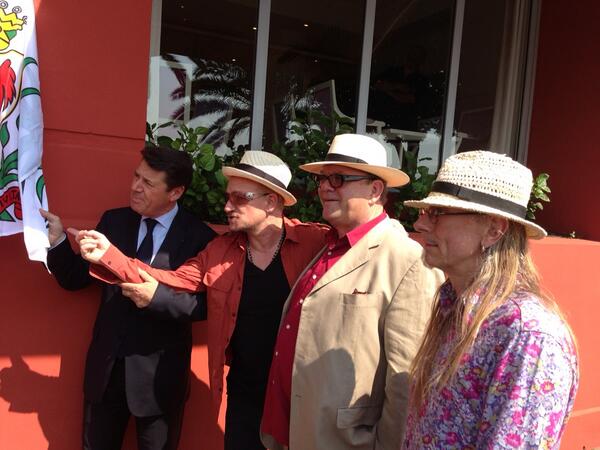
Meanwhile, Bono was on hand at a ceremony in Nice today unveiling a plaque in honor of Irish author James Joyce. The Irish ambassador was there, along with Paul McGuinness and Bono's longtime pal Guggi.

View image on Twitter
Bono, Paul McGuinnes, Guggi and the Irish Ambassador unveiling a plaque in honour  of Joyce


Wednesday, January 30, 2013

Paul McGuinness: Google isn't doing enough to fight piracy


Google has been making "encouraging noises" about restricting access to sites hosting pirated content, but it needs to take action, said U2's manager Paul McGuinness speaking on a panel at Midem(Marché International du Disque et de l' Edition Musicale)
McGuinness was talking about Google's promise to downgrade sites that host copyright-infringing content in its search engines. He said that he didn't want to engage in "Google-bashing" but that there was a sense of unease across Europe towards the search giant.
He then proceeded to bash Google for not applying itself properly.McGuinness admitted that Google has brought "so much to civilisation" in terms of spreading knowledge. "We all know they're ingenious, but they are making money from directing people to piracy sites." He called for Google executives to "apply themselves" to developing a system of microtransactions that could remunerate artists when someone listens to their music over the web. However, he believes that "they're not really doing what they could be doing in this space".
Michael Barnier, European Commissioner for Internal Market and Services, was keen to point out that he was firm on tackling piracy in addition to reforming copyright legislation. He called copyright an "essential driver" in the creative process, but said that if that right is not respected it is of little use. He showed particular disdain for those sites making money from advertising from hosting pirated content. "Is it acceptable to tolerate advertising revenues being gobbled up by service providers who foster the free sharing of illegal music files?" he asked.
He went on to criticise the fragmented nature of the European market, but was keen to point out that the situation had improved over the last three years. "But there are some istances of restrictions which Europeans have to suffer; the availability of music and unavailability of some websites is still uneven between member states. It's incomprehensible that Europeans are still facing obstacles on the internet that we've faced in the physical world for the last fifty years."
When the conversation moved to legal streaming services such as Spotify, McGuinness felt that the artist revenues were quite trivial even for huge stars. "You could say that these services are mainly a promotional medium," he said.
You can watch all of the Midem panels online. Or you can read Midem's liveblog of the session here.

http://www.wired.co.uk//http://www.ultraviolet-u2.com

Monday, January 21, 2013

Bono, The Edge and Paul McGuinness in "Lincoln" Premier in Dublin

Bono and Ali
Edge and Morleigh
Kathy and Paul McGuinness with Bono and Ali Hewson

http://www.worldirish.com

Tuesday, August 7, 2012

U2 360 Tour Book Available


From the Ground Up


U2: 360° - Um die Welt in 760 Tagen, (U2: 360° - Around the World in 760 days), chronicling the epic U2 360° production that toured from 2009-2011, is available in German from author Dylan Jones with photography by Ralph Larmann, with a release date of September 2012.

It can be ordered here for delivery in Germany at the moment. The book will eventually be published worldwide in several languages. As from 20th November, the book will be available from Random House.ca

From the Ground Up
U2360° Tour Official Photobook
Written by Dylan Jones
Illustrated by Ralph Larmann
Category: Music – Rock
Format: Hardcover, 300 pages
Publisher: Preface Publishing
ISBN: 978-1-84809-368-3 (1-84809-368-3)
Pub Date: November 27, 2012
Price: $39.95


Friday, May 11, 2012

'U2 1978-1981'


pic.twitter.com/TDuvKuJP


Paul McGuinness was at the Little Museum in Dublin yesterday night, launching an exhibition of rare photos from the earliest days of U2.
The photographs were taken by Dubliner Patrick Brocklebank, who worked as a graphic artist and photographer in the 1970s.

 'Because I was always in town,' recalls Brocklebank, 'And because we were the same age, I’d often see U2 around the place. The show records the energy and ambition of a local band that would later conquer the world.'

At the opening, Paul remembered being introduced to the band by Bill Graham of Hot Press. 'U2 tricked Bill into coming to one of their early rehearsals. They played him a few of their 'own songs' but Bill made them stop and said: 'hang on, all these songs you're playing are by the Ramones'.
'U2 said 'Okay, you're right, but we're going to write some great songs' and that's what they have been doing ever since.'

Paul recalled the music press and pirate radio stations of the late 1970s and reminisced about early  shows at Dandelion Market and the Project Arts Centre, when, on one occasion, a gang known as the 'Black Catholics' showed up.
'The Black Catholics were dedicated to breaking up other people's gigs. I gained an early and completely undeserved reputation for physical violence by taking one of them out into the street beside the Project.'

Also joining Patrick Brocklebank at the launch were luminaries from the Irish music scene and friends of the band including Gavin Friday, Niall Stokes,  John Stephenson - who ran the Project Arts Centre - and Dave Fanning.Bono was an absentee from the opening as he celebrated his 52nd birthday in the US with his family, including daughter Jordan Hewson -- who was celebrating her 23rd birthday yesterday.

"They sounded pretty raw. Off stage Bono was a bit loose with his tongue, The Edge seemed like an academic, Adam was a lad around town, but one with a purpose, and Larry was just a schoolboy," he said.

Indeed, the young Larry Mullen doesn't appear in some of the photographs because he was busy with schoolwork, with his place taken in the shots by Guggi, then a member of rival band The Virgin Prunes.

"Looking back it wasn't so much U2's music that impressed me. It was U2 as people," said Guggi.

Limited edition prints from the exhibition are on sale at www.littlemuseum.ie.

U2: 1978-81 will run at the Little Museum of Dublin until September 2nd. More here.

Top Pic: @Gpaul1972

UPDATE:  Pics of the opening of the exhibition here.  http://www.independent.ie/

Thursday, November 10, 2011

U2 not splitting up


McGuinness ends speculation on band's future in  an interview for Belfast Telegraph.
It's official - U2 are not splitting up. The band's manager, Paul McGuinness, last night flatly denied reports that the four school friends are going their separate ways after 35 years.
Known as the fifth member of U2, Mr McGuinness (60) has steered their career from local outfit to global superstars. Asked about the constant speculation that U2 have hit the end of the road, he said: "No, and I think I would have heard. Not all all. They are always working on the next record."
Fears of a U2 split began with an interview Bono gave to 'Rolling Stone' magazine last month in which he hinted that himself, Larry Mullen Jnr, the Edge and Adam Clayton may part company sometime in 2012.
"I'm not so sure the future hasn't dried up," said the 51-year-old frontman.
"It's quite likely you might hear from us next year but it's equally possible that you won't. The band may have finally run its course."
However, at the opening of a new stage version of Edna O'Brien's novel 'The Country Girls', Mr McGuinness said: "I'm not sure what was said, but I think it was a chance remark taken out of context. I would disregard it."


www.belfasttelegraph.co.uk