Showing posts with label Art. Show all posts

Wednesday, August 7, 2019

Bono and Guggi: A friendship based on art, punk rock and Jesus

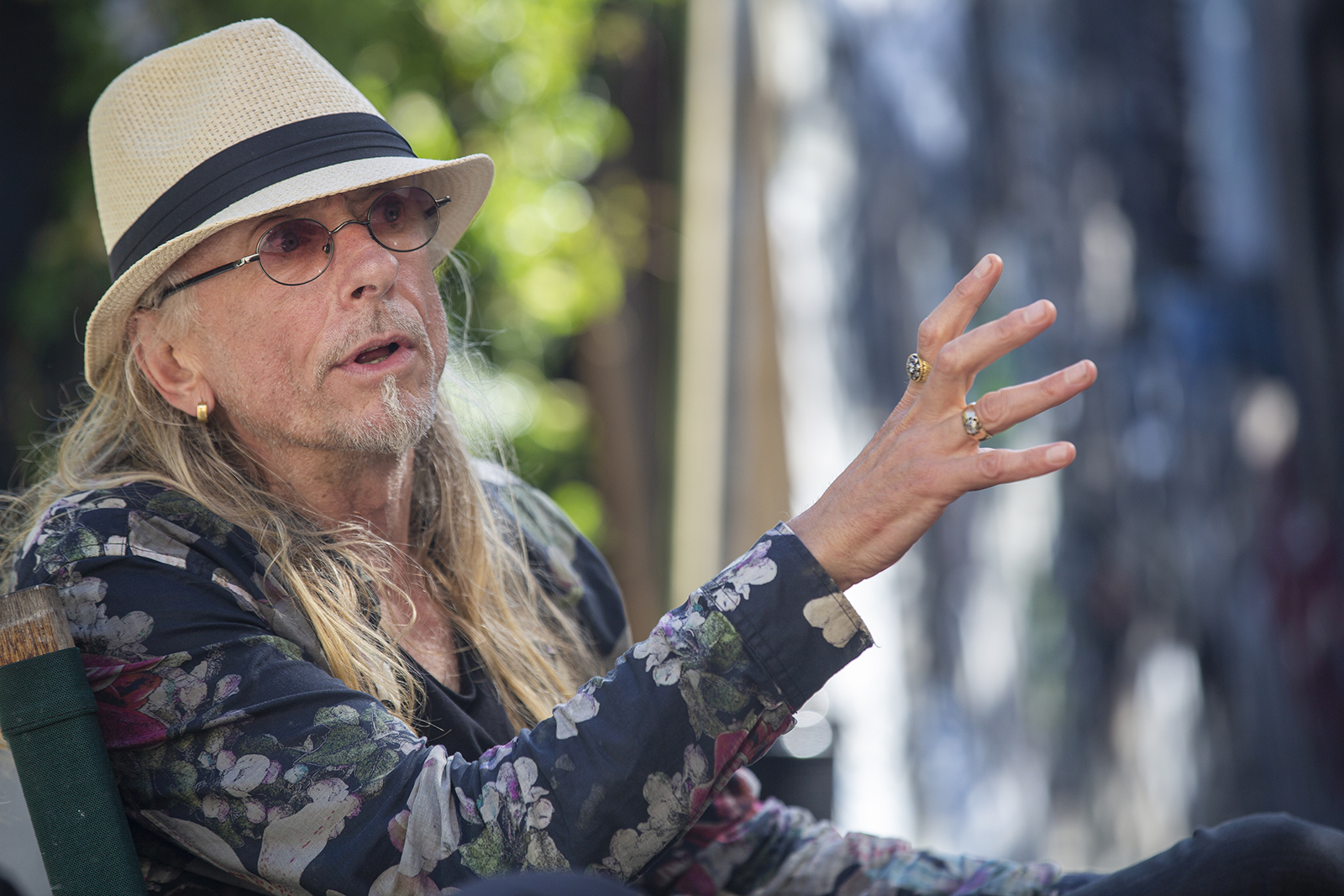
Artist Guggi discusses his background and his new show, “My Cup Overflows,” at Arcane Space in Los Angeles in June 2019. RNS photo by Bhushan Thakkar (www.20evo.com)
VENICE, Calif. (RNS) — At the height of Ireland’s sectarian Troubles in the early 1970s, when he was not long out of diapers, Paul Hewson met Derek Rowen, a neighbor boy from a few houses away in their working-class Finglas neighborhood of North Dublin.
The Hewson family lived at No. 5 Cedarwood Road.
The Rowens — all dozen of them — occupied No. 10.
More than 50 years (and two famous nicknames) later, Hewson, aka Bono of U2, and Rowen, the contemporary artist better known as Guggi, remain the best of friends.
As children, they bonded over a shared love of punk rock, mischief making and Jesus.
As men, they have channeled the spiritual, cultural and personal tumult of their youth into art.
For Bono, it became music.
Guggi, abstract art.
Musician Bono, left, and artist Guggi grew up together in Ireland. Video screenshots
“Myself and Bono, we weren’t like the other kids in the street and we knew we weren’t,” Guggi told Religion News Service recently during “My Cup Overflows,” an exhibit of his new works at Arcane Space, a gallery in the Venice neighborhood of Los Angeles co-owned by Morleigh Steinberg, wife of U2 guitarist The Edge.
“I was seen as an oddball, a freak,” said Guggi, who turned 60 in May and is 362 days older than Bono. “We didn’t know what to say when they would want us to name our favorite football players because we didn’t know any names. We could get beaten up for supporting the wrong team or not supporting anybody.”
One thing they did have in common was an interest in developing their Christian faith.
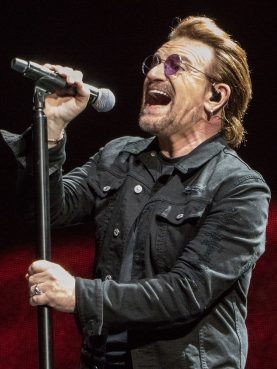
Bono performs on The Joshua Tree Tour in Indianapolis in Sept. 2017. Photo by Daniel Hazard/Creative Commons
Bono’s parents had what was considered to be a “mixed marriage” at the time — his father, Bob, was Catholic, his mother, Iris, Protestant. Bono and his older brother, Norman, were reared in the Church of Ireland (the Irish iteration of the Episcopal Church).
Guggi was rarer still in the predominantly Catholic Republic of Ireland, where he was born into a devoutly religious family rooted in the Christian Brethren (Irish cousin of America’s Plymouth Brethren) tradition. He is the second oldest of 10 children (seven boys and three girls).
Guggi brought up his own children religiously in one of Dublin’s Baptist churches. “It just happened to be a Baptist church — I’m not interested in brand names, I just wanted the message as it is in the Gospels,” he said.
His father, Robbie, who turns 86 this month, was and remains something of a zealot.
Bono once told me that the elder Rowen was “straight out of a Flannery O’Connor novel — it was like the prophet Jeremiah lived on our street.”
“I always remember the color of the language he used when he preached at us and the conviction of the words he used,” he told me in a 2005 interview.
Guggi describes his spiritual upbringing as “strict, Puritan,” and says his father ruled his family with an iron fist. And yet he had a genuine faith that has compelled a lifelong generosity.
“Bono came to his faith through my dad. And I came to faith through my dad,” Guggi said.
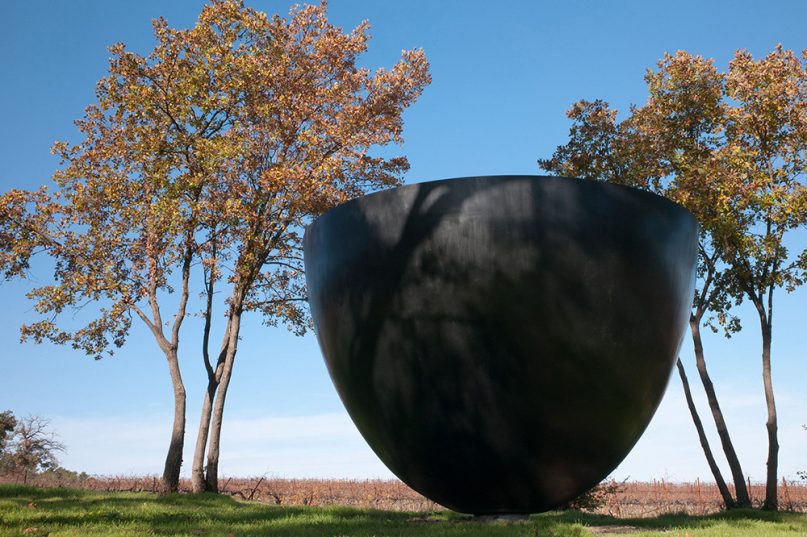
“Calix Meus Inebrians” by Guggi in France. Photo courtesy of Chateau La Coste
The eccentric elder Rowen was a virtuoso salesman, first for Eveready batteries and later for Raleigh and Peugeot bicycles, with a passionate, if sometimes overbearing, faith. He was also a consummate collector — of motorcycles, boats, “anything with wheels,” and once, a flock of sheep.
Bono’s mother, Iris, died when he was 14. After her death, Bono spent a lot of time at Guggi’s house, where he fell in naturally among the 10 Rowen siblings.
Guggi persuaded Bono to attend a Bible camp when they were tweens.
“My Dad would send us to the YMCA where they had something called the ‘boys department’ where boys went — not boys and girls, just boys — and the boys department went on a camp every year, Guggi said.
It was called “camping,” but it was more like sleeping bags on the rec room floor, he said.
“We slept in tents maybe a couple of times, but it was mostly school halls, church halls, that kind of thing, and yeah, myself and Bono went there every summer,” he said.
Like his friend Bono, Guggi tried his hand at music.
As a teenager, he formed a band, The Virgin Prunes, with Gavin Friday (another childhood friend of Bono’s), Dik Evans (brother of U2’s The Edge), and others.
The Prunes, who disbanded in 1990 and still have a hearty cult following in parts of Europe, incorporated elements of goth, performance art, and cross-dressing into their performances.
Guggi left the Prunes in 1984 to focus full time on his artwork.
It was about this time, at his grandmother’s funeral, that he heard a message that changed the way he understood his calling as an artist.
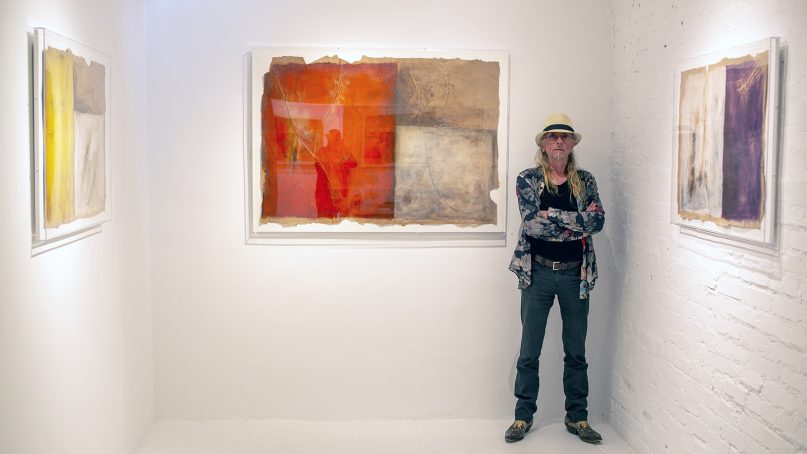
Modern artist Guggi poses with some of his “Broken” paintings at his exhibition, “My Cups Overflows,” in the Arcane Space in Los Angeles. RNS photo by Bhushan Thakkar (www.20evo.com)
“I’ve drawn and painted since I was a child, and I kind of started feeling guilty about it — what am I adding here? What am I bringing to society?” Guggi said. “But then this preacher at my grandmother’s funeral said, ‘If we are created in God’s image, we must in some way be like him. And if God is the creator, we must also be creative.’ That just struck a chord with me — that art isn’t just enough to do, it’s a special thing to do. I feel incredibly privileged to be able to paint, to be able to make pictures and sculptures.”
Now one of Ireland’s most celebrated modern artists, Guggi is perhaps best known for featuring empty bowls, jugs, spoons and other quotidian objects in his work, whether in oil, mixed media or sculpture.
Those works include a massive 15-foot-tall, 7,000-ton bronze bowl titled “Calix Meus Inebrians,” which stands among the grape vines at the Chateau La Coste vineyard in Aix-en-Provence, France.
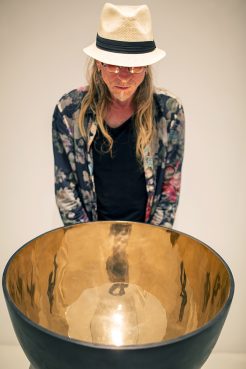
Guggi with his artwork “Poculum ex Vinea” at the Arcane Space in Los Angeles. RNS photo by Bhushan Thakkar (www.20evo.com)
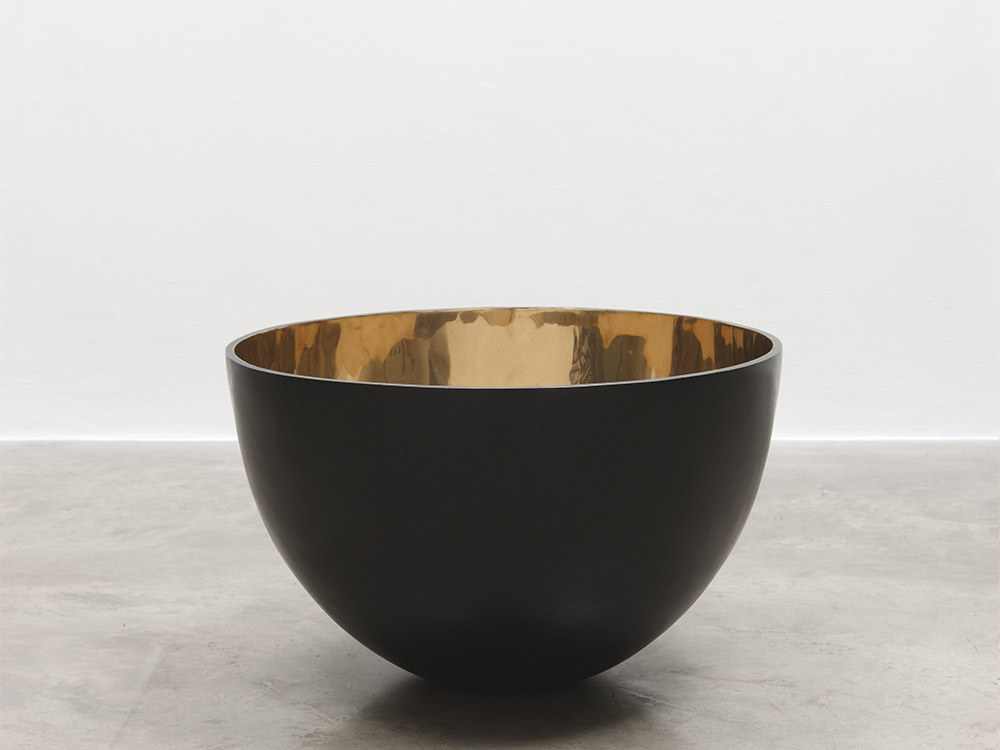
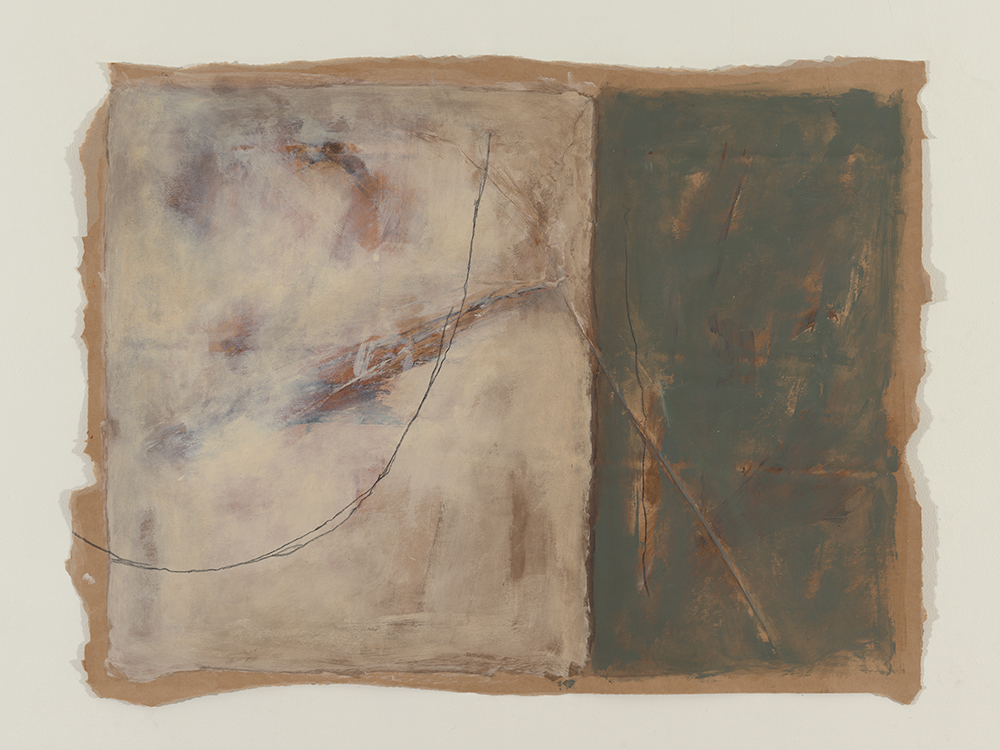
A 100-pound, nearly two-foot-tall bronze bowl titled “Poculum ex Vinea” (“a cup of vines”) is featured in Guggi’s new exhibition alongside a series of paintings on brown paper called “Broken.” The art historian and poet Kevin Grovier described the work this way: “By salvaging beauty from distress, soulfulness from fragmentation, Guggi creates objects from another world.”
The artist himself isn’t too keen on analyzing his artwork — “It’s not a verbal medium,” Guggi said.
He added that, “artists should be more like Victorian children: seen and not heard.” But he admits there is a spiritual connection to his habit of focusing on vessels and finding the sacred in the ordinary.
“I’m merely a channel, and it comes through me and I’m available for service in that sense,” Guggi said.
He started with portraiture, inspired by photos he took of a peculiar street preacher — a woman who was part of a fundamentalist Catholic sect.
“She would have a child’s glove in one hand and some literature or something in the other and she’d be waving it around,” Guggi said. “She was quite bonkers, but she did have a great face.”
He made countless abstract portraits based on the woman’s face until he realized what he was drawing wasn’t the curve of her face, it was a bowl.
“That was what led to taking simple, common, everyday objects that we walk past all the time, and we don’t notice are there, that are functional. I started painting these objects, and I never stopped,” Guggi said.
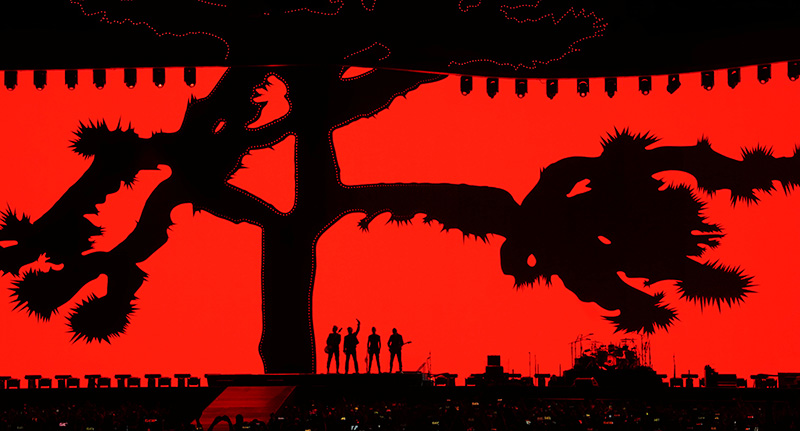
U2 on stage during the opening concert of their global The Joshua Tree Tour 2017 in Vancouver, British Columbia, Canada, on May 12, 2017. Photo by Nick Nidlick/Reuters
During the recording of U2’s “The Joshua Tree” album in 1985, Bono summoned Guggi and Gavin to their local pub, known as The Gravediggers, to ask a favor.
“He said, ‘Look, I want to paint. We’re putting this album together, we’re making this record, but I need to get away from that,’” Guggi recalled. “Bono always loved painting, and we painted together as children, as teenagers.”
Bono set aside a room in the large manor house where the band was recording “The Joshua Tree” and asked Guggi to fill it with art supplies, which he did.
The trio — Bono, Guggi and Gavin — joined by a fourth friend, Charlie Whisker, who would go on to direct videos for U2 and Bob Dylan among others, would gather on Wednesday nights to make art. A year after the album came out, the friends hosted a group exhibition of their work at a Dublin art gallery called “Four Artists, Many Wednesdays.”
The exhibit also included photographs Bono had taken on his first visit to Africa during the Ethiopian famine in 1985.
Modern artist Guggi, right, speaks with guests during an opening for his exhibition, “My Cups Overflows”, at the Arcane Space in Los Angeles in June 2019. RNS photo by Bhushan Thakkar (www.20evo.com)
Like most longtime friends, over a lifetime the men have shaped each other. For instance, both are fathers — Bono has four children, Guggi has five (all boys) — and have sons named Elijah. Bono’s oldest son is Elijah Bob Patricius Guggi Q Hewson.
When the lifelong friends speak, sometimes you can hear whispers of one in the other.
“I am a believer, 100 percent,” Guggi insists when the conversation circles back to matters of faith. “I’m not a very good example of one, but you’re either in or you’re out.”
Bono, whose lyrics are laden with spiritual and biblical imagery and who in recent years has been quite open about his Christian faith, has famously said, “I’m not a very good advertisement for God.”
On U2’s perhaps most autobiographical album to date, 2014’s “Songs of Innocence,” Bono dedicated a song to Guggi called “Cedarwood Road.” It says in part:
“I was running down the road
The fear was all I knew
I was looking for a soul that’s real
Then I ran into you…
Symbols clashing, bibles smashing
Paint the world you need to see.”
Guggi’s show “My Cup Overflows” runs through the end of August, by appointment, at Arcane Space.

Tuesday, May 7, 2019

The Wanderer

In case we've missed where he was...


With Eva Rothschild, representing Ireland at the 58th Venice Bienalle...Adam
(from @U2 twitter)

Friday, February 10, 2017

Adam: ‘I always thought music and art went hand in hand together’


Adam Clayton of U2 talks to Francis Outred, Head of Post-War and Contemporary Art, about his passion for the work of Jean-Michel Basquiat, a drawing by the artist offered in our London sale, and how art inspires the band

Francis Outred: When did you first become interested in Jean-Michel Basquiat?
Adam Clayton: ‘I first started to seriously learn about him in 1990 — I had some time off and had moved to New York to explore the art world, meeting gallerists and artists. It was just after his death, and there was a lot of energy around his work. He had been quite a character in New York — he would turn up to places in his Comme des Garçons suit splattered with paint and was very much part of the underground nightclub scene. He was around the same age as the musicians I was interested in, and would have been the same age as us. There was a group of artists — Basquiat, Keith Haring, and obviously Warhol was the granddaddy of the whole movement. The idea that these young painters without any gallery experience could make their mark on the streets of New York — could go to the hippest nightclubs, could mix with musical culture — was very exciting to me. It was where I came from — I always thought music and art went hand in hand together.’
FO: Can you recall your first encounter with this particular work?
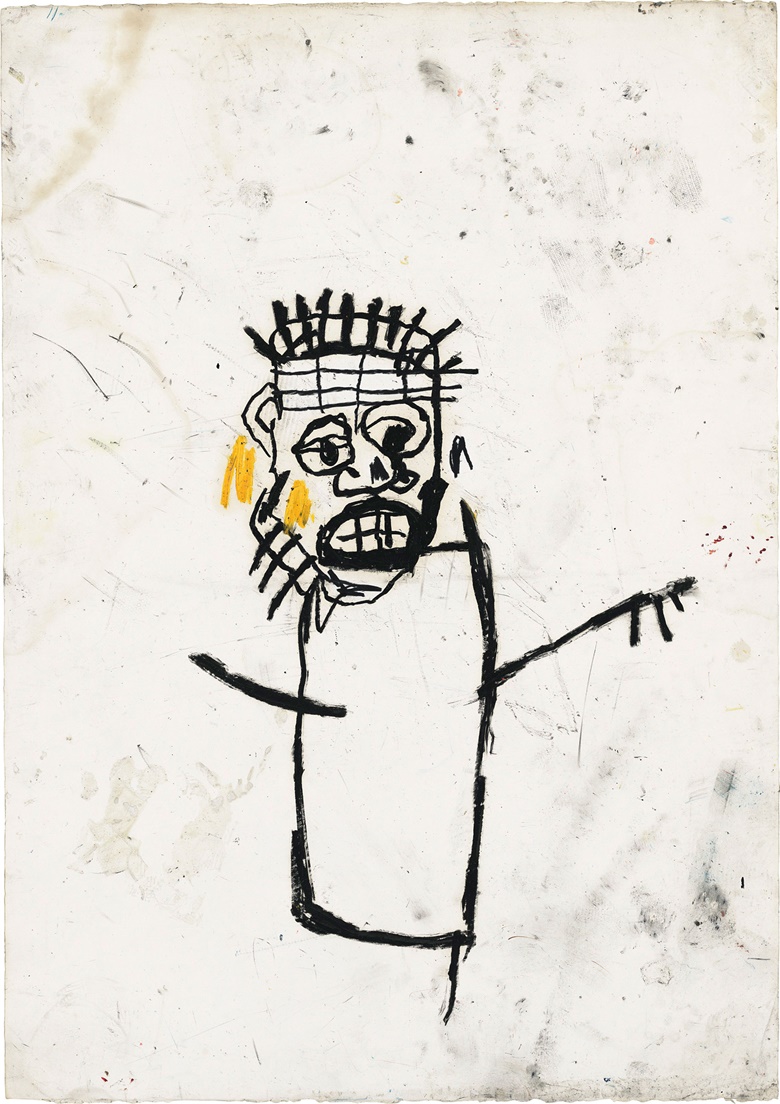
AC: ‘I was on 57th Street in the Robert Miller Gallery — they had just taken over Basquiat’s estate and were looking through the inventory. I definitely responded to the kind of work I would call ‘biological’, where there was a lot of archaeology in the skeleton and the bones. I had already selected a large painting that I thought would be a really great piece to share with the band and have in our studio, and we started to look through the works on paper. They were generally very complex, with lots of lines and activity, and this work stood out because it had a very tragic image — it’s clearly an unobscured self-portrait, with what looks like a tear drop coming from the eye. It seems to me it’s not just about Jean-Michel — it’s about being African-American.’ 
Jean-Michel Basquiat (1960–1988), Untitled, 1982. Oil stick on paper. 42⅝ × 30 in (108.3 × 76.2 cm). Estimate £1,000,000–1,500,000. This work is offered in the Post-War and Contemporary Art Evening Auction on 7 March at Christie’s London
Jean-Michel Basquiat (1960–1988), Untitled, 1982Oil stick on paper. 42⅝ × 30 in (108.3 × 76.2 cm). Estimate: £1,000,000–1,500,000. This work is offered in the Post-War and Contemporary Art Evening Auction on 7 March at Christie’s London
FO: The scale of the work, and the fact that it’s been walked over and lived with for such a long time in Basquiat’s studio, makes it very special. I’m interested that you hung a painting in your studio — did you and the band members share a passion for Basquiat?
AC: ‘In New York and in musical culture there was this shift happening towards much more dance-orientated music. It was the very early days of rap and hip hop, which was a very exciting time because it had a real energy, and it also indicated — finally — that the African-American voice within music had a really strong identity of its own. At the time people were talking about Jean-Michel as being the Jimi Hendrix of painting and I think that’s true — he was an African-American artist in a sea of white artists, but doing something very different and extremely his own.’
FO: Obviously your music transformed a lot at this time —Achtung Baby  was really a big breakthrough and quite a transition from Joshua Tree
AC: ‘With Joshua Tree  we were looking at a lot of US music and trying to reinvent the form, and at the same time tackling the darker side of what was going on in America. With Achtung Baby, which came a couple of years after, we were thinking about a different sound and the technology at that point meant you could add more computer sounds — you could sample sounds and generate them. This was all happening within club culture, so it felt as though we were all working off the same palette.’ 

FO: Do you think that living in New York changed your perception of Basquiat’s work?
AC: ‘It was a great time to be in New York as a young creative, because everything was possible at that point. There were underground clubs, the gallery system didn’t exist downtown in the way that it does now, and if you were an artist you were pretty much free. There wasn’t a system that you had to be part of in order to have access to collectors, and I think that was very much part of Jean-Michel. It’s also part of young artists; they don’t want to work the system as much — they actually just want to make the work. It was the very early days of what the art world was about to become.’
FO: When I look at this work, the arms remind me of arrows going into the body — it’s almost as if he’s portraying himself as a victim. This is a portrait of Basquiat having just exploded on to the art scene in 1982, and possibly feeling the repercussions of this new world. Did you as musicians, who had a similar kind of growth, find that kind of exposure troubling, or were you more prepared for it?
AC: ‘I think whether you’re prepared or not, you understand that the idea is to get your work to the greatest number of people possible, because you want to share it. I think the art world works a bit differently, in that you want to get it to an influential number of people and you want to get it into museums, so you have a different relationship with it — I think that’s where the two goals separate. I think you’re right about the arrows in this work — it’s one of the very few genuinely stark images that he ever produced of himself without adding anything else to it. It’s an incredibly disciplined drawing, but that’s what makes it so powerful. He represents himself with the crown in a lot of his works, but this picture has a pathos and, in some ways, is an antidote to all the noise surrounding his work and all the attention it’s had over the years. It brings you back to the artist and his difficulty of fitting into that world.’ 
FO: That’s true, a lot of his portrayals of himself are very confident — with his arms raised, powerful and athletic — and here you have the direct opposite: a fragile figure who’s coming to terms with a new kind of normality. How do you see the relationship between the paintings and the drawings?
AC: ‘I think the drawings were where he worked out ideas — a lot of images migrate towards the paintings, but I think the drawings are a direct connection with him. You can imagine him with an oilstick or a piece of charcoal working on a piece of paper over a couple of hours — you can see that concentration.’

FO: This was a time of great success in your career. How does this work fit into that story?
AC: ‘My antidote to being on the road or in the recording studio has always been the opportunity to get out and see artworks. It’s a much more meditative environment for me, so when I see works that really speak to me I like to acquire them if I can. By bringing them into my home, they become something I have a direct relationship with — I went and saw them, I went and bought them, I brought them into my space, and they very much keep on giving. It becomes a cyclical relationship, and that was very much true of this particular drawing. Being in New York certainly marked the beginning of my ability to understand and follow contemporary art, and I’ve continued to build on that.’

The  work of art owned by U2 bassist Adam Clayton is expected to fetch £1.2 million at auction.

http://www.christies.com


Tuesday, December 15, 2015

Bono & Ali with fashion designer John Rocha

Bono and John Rocha at the unveiling of a portrait of the designer by artist Geraldine O’Neill at the National Gallery of Ireland in Dublin. Left, Ali Hewson. Photo: Arthur Carron.


"It feels like Christmas Day," fashion designer John Rocha exclaimed at the unveiling of his portrait in the National Gallery of Ireland last night.

It was a small but star-studded affair with Bono, Guggi, Ali Hewson and John's designer daughter Simone all attending the event.

"I'm a very big fan of John's," Bono told the Irish Independent.

"He's an extraordinarily talented man and an extraordinary gift to our country."

A portrait of the U2 frontman once graced the walls of the gallery but Bono believes the curators took it down "after the release of the last album" on iTunes.

Artist Geraldine O'Neill, who was shortlisted for the inaugural Hennessey Portrait Prize in 2014, created the impressive piece of work which shows Rocha standing in front of swathes of fabric.

"He was a fantastic person to paint," O'Neill said.

"I don't paint that many portraits but we just clicked straight away. It was an extremely enjoyable experience."

Top designer John was joined by his wife and business partner, Odette, his fashion designer daughter, Simone, and his new granddaughter, Valentine.

"I'm thrilled," John said. "It's the highest honour I've had in this country, it's a wonderful occasion and a very special night."

Rocha is the latest in a series of well-known figures in Irish life to enter the National Portrait Collection.

He follows in the footsteps of Sr Stanislaus Kennedy, Michael Longley, Seamus Heaney, Brian Friel, Maeve Binchy, and Mary and Nicholas Robinson.

Born in Hong Kong, John Rocha moved to London in the 1970s to study fashion in Croydon College.

He was inspired to move to Ireland having used Irish linen in his graduate collection.

He has lived and worked in Dublin for the past 35 years and is considered one of Ireland's best regarded designers.

In 2002, he was awarded the CBE in recognition of his contribution to the fashion industry and opened his flagship store in Mayfair in 2007.

Last year he announced his retirement from London Fashion Week and the catwalk, saying that he wished to "live by my calendar and not that of Fashion Week".

During his career, he has also worked extensively with crystal, jewellery, architecture and interiors.

Bono and Ali Hewson at the unveiling of a portrait of John Rocha by artist Geraldine O'Neill at the National Gallery of Art in Dublin. Picture: Arthur Carron

Tuesday, September 15, 2015

HUMAN CHAIN


Last Sunday, September 13, Art for Amnesty and Amnesty International (along with the Italian NGO Insieme Si Può) is assembling 6,000 supporters to form a 10km human chain to encircle the iconic Tre Cime mountain, 90 minutes north of Venice in the Dolomites in northern Italy. 

It’s all in support of Amnesty's refugees campaign, which the band are promoting on the current European dates. And it’s a chance for anyone in striking distance of the Dolomites to try to throw their arms, if not around the world, then at least around the mountain, in solidarity. The event comes ahead of next week's emergency EU meetings  about the refugee crisis affecting Europe. 

Bill Shipsey, the barrister from Dublin who set up Art for Amnesty in 2002, has maintained Amnesty’s friendship with U2 since meeting the band at the opening of the Irish Amnesty Office in 1984. “I often say that if I had a Euro for every person who told me they’d got involved with human rights or Amnesty International because of U2, I’d be very wealthy,” he admits.

The focus, he explains, of Amnesty’s refugees campaign - and of the human chain in Italy this weekend - “is to persuade predominantly European countries to take 380,000 of the 4 million Syrians that are recognised as refugees but are in camps in Lebanon, Jordan, Turkey and Iraq.”

There are strong links and a rich heritage between Amnesty and the arts which helps the cause enormously. “If you want to get people motivated, that’s where the arts and artists really come in,” he says. “A song, a poem a piece of beautiful writing - they will get you many more supporters than just telling people about the universal declaration of human rights.”

Indeed, the head of Refugee and Migrants Rights for Amnesty International, Sherif Elsayed-Ali, is “a young Egyptian who came to hear of Amnesty through watching poor quality U2 videos in Cairo.” 

The logistics for the human chain this Sunday are not simple. Six thousand people will be taken on a 45-minute journey up the mountain in 120 bus-loads. But it’ll be worth it. And if there’s a key message to U2 fans from Bill Shipsey, whether they can make it or not, it’s this: “Take injustice personally. Whatever the issue, please take injustice personally, and act.”

*     *     *

If you want to link arms physically with the human chain in northern Italy, you can find details of where to come and what to do here.

If you want to do something else in solidarity, Art for Amnesty is encouraging groups to form their own smaller human chains - there’ve already been chains formed around Wenceslas Square in Prague, and around giant redwood trees in California.  Upload your photos on social media with the hashtags #humanrightschain or #refugeeswelcome. Or simply tweet your support for the human-rights chain this Sunday, again, using the hashtag #humanrightschain or #refugeeswelcome .

Friday, August 14, 2015

Tony Hawk recruits U2 to customize skateboard


Professional skateboarder  Tony Hawk has partnered up with Ben Harper to create Boards + Bands, a fundraising initiative for Hawk’s eponymous foundation. Hawk hit up some of his skater buds, including Ryan Sheckler, Chad Ortiz and Nyjah Huston, to donate one of their boards and then pick one of their favorite songs. Harper then approached those musicians with one simple instruction: “Please write the lyrics to this skater’s favorite song on his skateboard, and we’ll use it to create more skateparks for kids.” Among the musicians participating in the collaboration are , U2, Pearl Jam, Of Mice & Men, Jay Z, Metallica,Tenacious D and more.


“We are thrilled about this year’s amazing collection of boards featuring unique collaborations between some of the biggest names in skateboarding and music, and we are grateful to all that made it possible,” says Hawk in a statement. “We have high hopes for this year’s auction as we continue to further the Foundation’s mission of bringing skateparks to low-income communities around the world.”

You can see all the custom boards as well as place a bid here

Thursday, November 27, 2014

Bono: Comic Super-Hero


New comic book details Bono's life and career


A new comic book chronicles U2 front man Bono's life in vivid color.

The life of U2's front man Bono is the subject of the latest edition of Bluewater Production's Fame comic book series. The glossy tracks the Irishman's boyhood, his music career and humanitarian work. It also features Bloody Sunday, the 1972 shooting of protesters in Northern Ireland, which later inspired the U2 single, Sunday Bloody Sunday. "Fame" is available in print and digital form on November 19.

Written by  Michael L. Frizell with artists, David Frizell (cover), Gary Scott Beatty(letterer), and  Jayfri Hashim (colourist, penciler).


Friday, November 21, 2014

Films of Innocence

U2: Films of Innocence


11 of the world’s most acclaimed urban artists unveil their work through a collection of art films, inspired by U2’s Songs of Innocence. Taking the political murals of Northern Ireland as a reference point, U2 pioneered the project to celebrate the unique democratic power of urban art. Oliver Jeffers, Robin Rhode, D*Face, Mode 2, Chloe Early, Ganzeer, Vhils, Maser, ROA, DALeast, and Todd James make up this global multidisciplinary group project. Chosen for their undisputed ability to capture the imaginations of their audiences, the artists were given complete creative freedom to showcase their personal responses to U2’s music, through a series of part-animated, part live action films. The result is an exhilarating display of diversity in approach, style and commentary. Powerful and cognizant, their works scale the globe, play with time, and weave between heightened reality and animated dreamscapes. United for the first time in film, the eleven international artists have taken their work from the streets to the screen. These original works of video art transpose their visions from the physical to the digital and are collected here together as a visual counter-point to the album, a set of unique and compelling Films of Innocence.


Available on I-Tunes.

Friday, May 23, 2014

"Even better than the real thing"

90342024

90342005


90342000


90342008


90342009

London artist Fin Dac paints the Edge and Bono on the first floor of the Gibson Hotel in the Point Village, Dublin. The painting is called "Even Better Than The Real Thing"


http://www.broadsheet.ie/http://findac.tumblr.com/

Wednesday, November 27, 2013

"Ordinary Love" in Vinyl

u2 ordinary love vinilo

"Ordinary Love", the song U2 made for the biopic Mandela, Long Walk to Freedom, has been released in vinyl by Interscope Records.

Danger Mouse(Brian Burton) appears in the credits as producer of the new song  and side B song, "Breathe" is produced by Declan Gaffney.

Both were recorded at Electric Lady Studios, New York.

The cover has been made by www.ampvisual.com  and is based on Oliver Jeffers' art.

Tracklist: 
U2 ‎– Ordinary Love
Label:Interscope Records ‎– B0019655-11
Format:Vinyl, 10″, 33 ⅓ RPM, Limited Edition
Country:US
Released:29 Nov 2013
Genre:Rock
Style:Alternative Rock, Indie Rock
A Ordinary Love 3:39
Additional Backing Vocals By – Angel Deradoorian
Additional Production By – Declan Gaffney
Additional Recording By – Grant Ransom, Ben Baptie and Barry Gorey
Additional Synths and Piano By – Declan Gaffney and Brian Burton
Assisted By – Ben Baptie
Backing Vocals By – Edge and Larry Mullen Jr, The
Lyrics By – Bono
Mixed At – Electric Lady Studios, New York
Mixed By – Tom Elmhirst and Danger Mouse
Music By – U2 & Brian Burton
Producer – Danger Mouse
Wurlitzer and Synth By – Barry Gorey
B Breathe (Mandela Version) 4:02

Assistant Engineer – “Classy” Joe Visciano
Backing Vocals By – Edge, Larry Mullen Jr, and Adam Clayton, The
Lyrics By – Bono
Music By – U2
Producer – Declan Gaffney
Recorded At – Electric Lady Studios, New York


Friday, October 18, 2013

Bono joins niece Leah Hewson at her art exhibition 'Cusp'

Bono y Leah Hewson


Bono joins niece Leah Hewson at her art exhibition 'Cusp' at The Picture Rooms, Wellington Quay, Dublin.


http://www.independent.ie

Friday, October 11, 2013

U2 and wives share the spotlight at artist Anne Madden’s exhibition

Anne Madden with U2's Bono,The Edge and Larry Mullen at the opening of her exhibition of art at the Taylor Galleries on Kildare Street, Dublin.  (Picture:Arthur Carron/Collins)
Anne Madden with U2's Bono,The Edge and Larry Mullen at the opening of her exhibition of art at the Taylor Galleries on Kildare Street, Dublin. (Picture:Arthur Carron/Collins)


U2 turned out to support "an old friend" and add a touch of superstar glamour to artist Anne Madden's new exhibition. Bono, the Edge and their wives Ali Hewson and Morleigh Steinberg attended the opening of 'Dark and Light', Madden's first exhibition in four years. Drummer Larry and his other half Anne Mullen followed shortly behind and U2 bass player Adam Clayton was the only member of the band not present. 

Bono's wife Ali Hewson and Edge's wife Morleigh Steinberg at the opening of an exhibition by Anne Madden at the Taylor Galleries on Kildare Street, Dublin

Bono's wife Ali Hewson and Edge's wife Morleigh Steinberg at the opening of an exhibition by Anne Madden at the Taylor Galleries on Kildare Street, Dublin


 London-born Madden established a friendship with U2 over 20 years ago and the group have been collectors of her work for more than a decade. 
 "I met them in 1984 at an Amnesty International event," Madden told Independent.ie. "I had no idea who they were at the time, they gave us the Joshua Tree album, which I'd also never heard of. "They're old friends now." 
 Her exhibition of work has been unveiled a year after the death of her celebrated husband Louis le Brocquy. Madden's work is on display at the Taylors Galleries on Dublin's Kildare Street until October 26.


U2 manager Paul McGuinness with Anne Madden at the opening of an exhibition of art Dark and Light by Anne Madden at the Taylor Galleries on Kildare Street, Dublin

U2 manager Paul McGuinness with Anne Madden at the opening of an exhibition of art Dark and Light by Anne Madden at the Taylor Galleries on Kildare Street, Dublin


LAURA BUTLER – 10 OCTOBER 2013