Showing posts with label Songs of Experience. Show all posts

Friday, March 16, 2018

U2 THROUGH THE LENS OF FRIENDSHIP: AN INTERVIEW WITH JULIAN LENNON


Someone to look up to
 'Someone To Look Up To'– Copyright Julian Lennon 
Photo used with permission. 


Throughout the years, U2 has collaborated with many fellow artists, from legends they admire to fresh talents emerging on the scene. One such artist is their contemporary — acclaimed musician/photographer/humanitarian Julian Lennon. In addition to photographing the band over the years, Lennon is a backing vocalist on the track “Red Flag Day” from Songs Of Experience. In the following interview, conducted via email, Lennon shares details of their history together as artists and friends, his contribution to their current album, and the thousands of photos he still has of the band, which have yet to be released.


TK: When did you first meet/become friends with U2? 

JL: To be honest, I couldn’t tell you the first time … it could have been at the Formosa Cafe in L.A. about 30 years ago. We kept bumping into each other until eventually they asked me if I’d like to come to one of their shows, and I think the first time I went was because we had a security guard in common, Jerry Mele, who used to work for me, but was now working for them. I recall Oasis were their opening act, it was in the U.S. many, many moons ago … but I have a terrible memory, so can’t be sure. ;)

[Editor’s note: Oasis only opened for U2 twice, so the show Lennon references must have been in Oakland in 1997.]

TK: In an interview a few years back, you mentioned a treasure trove of U2 photos you took that weren't released because they were being saved for possible use on an upcoming U2 album. Since they don't appear on Songs Of Experience, will they be held for a future album or released in a different way? 

JL: Well, I have about 8000+ pictures, not all good by any means, as I was just starting to get into photography then, so a lot of blurry shots! But sometimes that can work too as a medium, as a more artistic slant to the conversation, so to speak. There are a few plans in the works with some of the images, for potential one-offs and limited edition images, but I really do need a month to go through all of them again, as I’ve had so many other projects to deal with in between. I’ll get around to them sooner than later ...

TK: If/when they're released, is there any chance of an exhibit of U2 works, exclusively? Is there any way to purchase any of your U2 prints that have already been displayed?

JL: I’ve already had exclusive U2 exhibitions, one as part of my first-ever exhibition, at the Morrison Hotel Gallery in NYC. I’ve had many since with them in Europe too, in Paris, when they were also performing there. The “Timeless” Collection (U2 inclusive) has been available for sale and to view on my photography website since 2010.

TK: I had the pleasure of interviewing artist Morleigh Steinberg in December, who co-owns the Arcane Space in Venice, California. She spoke of wanting to display a diverse array of artists/photographers. Any chance of exhibiting there (U2 content or not)?

JL: I had the pleasure of dining with The Boys a few nights ago, and Edge mentioned this too … it’s always a possibility.

TK: Fans were delighted to hear your backing vocals on "Red Flag Day.” How did the band approach you to work on that track?

JL: I went to visit U2 whilst they were working on the track, whilst they were still playing with the vocal arrangements, and B just said, “Jules, try this melody, it’s more suited to your tonal range” and that was it, I just sang along. Sometimes with Bono and Edge, sometimes solo, and my voice was blended into their background vocal tracks. I can’t really hear myself in there, but hey … happy to be part of it, regardless … ;)

TK: Throughout your musical career, you've collaborated with several of your contemporaries. What's it like working with U2 compared to others with whom you've recorded? 

JL: Well, I’d hardly say I was working with them, as such, it was more like a little bit of fun for 5 minutes … The Boys are pretty low key when recording, and don’t often like having people around, so it’s always a pleasure to get the odd invite, if we’re in the same city, to hang out, talk about the World, and music, etc. etc.

TK: Any chance of you joining U2 on stage when they (presumably) sing "Red Flag Day" on their upcoming tour?

JL: Ha … Doubtful … If it was a “Proper” Duet as such, maybe there would be, or even an old classic like “Stand By Me,” which Bono and I have sung together now on quite a few occasions, but I think that decision is always last minute with Bono. He, and the rest of the guys, have to be feeling it, so to speak … I think it’s a show-by-show experience and decision.

TK: Would you ever want U2 to contribute to any of your future songs?

JL: I play them the odd song, here and there, listen to what they have to say … I think we’re both quite particular in our approach to songwriting, but never say never … who knows?

TK: As a fan, do you have any favorite U2 songs or albums?

JL: Of course … too many to mention … “Sunday Bloody Sunday,” “One,” “Vertigo,” “Hold Me, Thrill Me, Kiss Me, Kill Me” … the list goes on. It’s more a case of which few I don’t like ... that would be easier! ;)

TK: In addition to musical gifts, you also share a common spirit with U2 in the humanitarian sense. Your White Feather Foundation does everything from bringing clean water to African communities to preserving indigenous people's territories in Australia. Tell us more about your foundation and how our readers can help if they'd like to get involved.

JL: In all honesty, the easiest way to know what we do, and to learn the story behind The White Feather Foundation is to go to our website, and read up on our projects … otherwise I’d be writing a few pages out for an answer.

TK: Your new children's book, Heal The Earth, was just released. Tell us about it.

JL: Well, it’s part of a trilogy to help children understand, in story form, the problems we face as a society, on a humanitarian and environmental level, and what we can do about those problems … but it’s more about starting a conversation with the next generation, at an early age, so they understand what’s happening to the world that they are going to inherit, and that there are possibilities for change, for the betterment of all life.

TK: Heal The Earth is the second in a trilogy. When can we expect the third book to arrive?

JL: Same time around, in the 3rd year … ;)

TK: At one point it was mentioned you may be writing an autobiography ... is that in the works? You seem to always have a lot on your plate.

JL: I’m never not busy, one way or another. If I don’t have a project, or 2, or 3 on the go, at any given point in time, I start to worry that I’m not doing enough, for Myself, for My art, for the World. The autobiography is still a consideration, but I’ve just [got] too much going on to consider that as an option right now.

TK: Fans of your Instagram feed (myself included) have really enjoyed your stunning photos from Cuba. Will those also become an exhibit? 

JL: Most of the Instagram shots that were seen were shot with an iPhone, so not really the quality that’s needed to put a show together, but I did take along a new camera that I recently purchased, the Sony AR7 III. Though the pictures won’t be identical to the iPhone pics, there are many that are very similar, so yes, there’s every chance they may become an exhibition at some point, but I’ve just finished editing all of my Cuba/Havana images, which will become a “Collection” on my photography website very soon ...

TK: What's the one question that journalists never ask you that you wish they'd ask?

JL: Am I happy? :)


(c) @U2/Kokkoris, 2018.

 Lennon’s new book, “Heal The Earth,” will be released on April 3 and is available now for pre-order on Amazon. The third book in the trilogy will be released on or around Earth Day, 2019. A direct link to his U2 photography is here.

Monday, January 29, 2018

60th Grammy Awards

During the 60th Annual Grammy Awards, U2 performed “Get Out of Your Own Way” from a barge in front of the Statue of Liberty. As the song ended, Bono referenced Donald Trump’s recent disparaging remarks, shouting, “Blessed are the shithole countries, for they gave us the American Dream.” (It was censored on live TV.) The lines were a variation of Kendrick Lamar’s lyrics from the studio version of the track.  Earlier in the evening, Bono and the Edge participated in Kendrick’s opening performance; they did “XXX.”


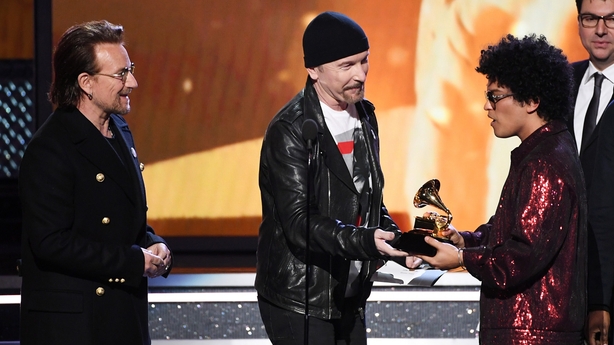
Later Bono and Edge  present Bruno Mars with the Grammy for Album of the Year for 24K Magic.

Wednesday, December 6, 2017

‘Songs of Experience’ by U2 Review: Rocking Its Classic Sound

The raw, lean authority at much of the new disc’s core harkens back to some of U2’s best albums.

By Jim Fusilli
U2's new album is ‘Songs of Experience’
U2's new album is ‘Songs of Experience’ PHOTO: OLAF HEINE


As its title suggests, U2’s new “Songs of Experience” (Interscope), out now, is kin to the band’s 2014 release, “Songs of Innocence.” Because the group took a different approach to recording the latest album, “Experience” surpasses its predecessor and connects to some of U2’s earlier, superior works.

The titles allude to William Blake’s late 18th-century poetry collections of the same names. “Songs of Innocence” is Blake’s rumination on an idyllic childhood that too soon exists only in memory. Similarly, on U2’s recording, Bono explored his teen years in Dublin, his burgeoning awareness of a larger world, and his appreciation of family and the musical heroes of his youth.

But as compelling as were Bono’s narratives, some of the “Songs of Innocence” music was at a distance from U2’s best instincts. The band has long incorporated the latest techniques in music-making into its sound, but here the muddied environment was unnecessarily overburdened with additional instrumentation contributed by the album’s five producers. Played by just the quartet when U2 took them on the road, as documented in the 2016 film “Innocence + Experience: Live in Paris,” the songs hit with power.

For “Songs of Experience,” U2 again deploys a battery of producers, thus hinting it is following the previous album’s template. When it played the beefy new ballad “The Little Things That Give You Away” earlier this year on tour, the song opened with the Edge on piano and the dull huff-ting of a drum machine. But that arrangement isn’t the one on “Songs of Experience.” Instead, the track builds to a fury with the classic U2 sound under Bono’s voice.

It’s been reported that U2, not satisfied with the new album’s direction, went into a New York studio in March with longtime associate Steve Lillywhite and re-recorded the music live without additional musicians. The raw, lean authority at the core of much of the album supports that claim. Instrumentation retained from earlier sessions and appended to the live tracks distracts as often as it enriches. But “Songs of Experience” confirms that bassist Adam Clayton and drummer Larry Mullen Jr. can still create a bottom so supple and sturdy that the Edge has ample room to chug, chime and roam above them on guitar.

That rhythm section is relentless on “The Blackout,” which blends the punch of rock with the snap of funk. “Summer of Love” and “Red Flag Day” are crisp and clear with the bass and the Edge’s guitar in pleasing relief. After Kendrick Lamar’s riff on Jesus’ Sermon on the Mount kicks off “American Soul,” the song profits from the band’s heaviest performance on the disc. If “Songs of Experience” peters out with the cliché-ridden ballad “Love Is Bigger Than Anything in Its Way” and soppy “13 (There Is a Light)”—both of which seem to have been made by committee—the band hasn’t lost its instinct for clever pop: “The Showman (Little More Better),” which features the Edge’s acoustic guitar and a seductive performance by Mr. Mullen, is as catchy as can be.

In his “Songs of Experience,” Blake posits mankind as trapped and forlorn but able to transcend its dire circumstances through love and a refusal to submit to hypocrisy. Bono’s storytelling has long reflected a parallel view. Here, after acknowledging in “The Little Things That Give You Away” that “Sometimes I’m full of anger and grieving / So far away from believing that any sun will reappear,” in “13 (There Is a Light),” he sings, “You start with nothing / You start with a void / Love is all we have left.” The theme of “Love Is Bigger Than Anything in Its Way” is its title.

Bono tackles big issues, including his own mortality. Addressing his recent health problems in “Lights of Home,” he writes, “I shouldn’t be here ’cause I should be dead.” He restates his love for America: “This country is to me a thought that offers grace for every welcome that is sought,” he sings in “American Soul,” while conveying a sense of despair in “The Blackout”: “Democracy is flat on its back, Jack / We had it all and what we had is not coming back.” That Bono can be both a pontificating, steel-willed figure and a musician who opens his heart to admit self-doubt serves well a quartet whose great strength is its mastery of musical melodrama in the rock idiom.

Thus, at its best, “Experience” is in line with “How to Dismantle an Atomic Bomb” and “No Line on the Horizon,” U2’s finest 21st-century albums. Now in its fifth decade, it remains a great band that works best when it’s self-reliant and rocks with clarity and determination.

Mr. Fusilli is the Journal’s rock and pop music critic. Email him at jfusilli@wsj.com and follow him on Twitter @wsjrock.


https://www.wsj.com

Saturday, December 2, 2017

‘It was like giving birth’: Andy Barlow on producing new U2 record Songs Of Experience

The follow-up to 2014’s Songs Of Innocence is out on Friday, December 1
DANIEL GUMBLE

Raising the bar: Andy Barlow

Producer, mixer and sound engineer Andy Barlow has spoken exclusively to PSNEurope about his production work on new U2 album Songs Of Experience and how he also became the legendary rock outfit’s live sound design consultant.

Released Friday, December 1, Songs Of Experience is U2’s 14 studio album and is the follow up to 2014 album Songs Of Innocence. Already being hailed by critics as one of the band’s best records in years, Songs Of Experience sees U2 incorporate the many talents of some of the most revered producers in the game, including Barlow, Jacknife Lee, Ryan Tedder, Steve Lillywhite and Jolyon Thomas.

Barlow’s relationship with U2, however, extends beyond the confines of the studio, having served as live sound design consultant for some the band’s notoriously spectacular shows.

Here, Barlow tells us how he wound up hitting the road with one of the biggest rock bands of all time, what it’s like to work with Bono in the studio and why making Songs Of Experience was “like giving birth”…

You’ve been working exclusively with U2 for the past two years as producer and mixer and as a consultant on sound design for their live tour. How did that come about?

Becoming their live sound design consultant happened quite casually. I was on tour with them as producer and Bono said, There are a few things we need help on including our walk-on music, would you be interested in helping us? And a few days later he said, You’re one of the live creative team now, and that was it. Because I’m an artist as well, and been on stage lots of times, I guess I was the obvious candidate to try out for it. Bono feels that when you are in the studio and the red light comes on, you are more forced to come out with ideas because that red light is on. So writing and recording on tour, in dressing rooms, backstage, the red light isn’t on and ideas flow much more effortlessly.

Tell us about the live role. The band are known for their spectacular live shows – were their any particularly unusual requests or challenges?

I’d never done the live role before and it’s a really long show. U2’s live show is over 2 hours long, and on some gigs it would be extremely demanding on Bono’s voice. Their schedule was pretty gruelling so I needed to step in and help. I would think about set list sequencing and change keys to spare his voice, listen to his voice on every section and speak to him about which parts were most demanding on his vocal chords, change the running order and find new ways of singing parts of the song. The extremes from low baritone to falsetto is much more of a strain on his vocals than anything else, so it was about looking at that and lessening the intervals and placing them differently on the live set so that we could get through the show without his voice deteriorating. Bono needed creative ways to retain his vocal power, and he was to be able to finish the yearlong tour around the world.

You produced five tracks on the new record. What was that process like?

It was bit like giving birth. The thing about U2 is if you think you know what it’s like to produce bands, working with U2 would confuse you because they do things completely differently to everyone else. For example, usually you have to win the trust of the musicians before they let you get stuck in with directing, but Bono from the first moment was without ego. He is more open to new ideas than anyone that I’ve ever worked with. When Bono would come in, he would come in with a verse, then another verse, then another verse, and I’d record all of them and Bono would then say, It’s up to you, you pick the one you like’.

Trying to write and record an album while rehearsing for shows is hard for a band, but as we progressed, it spearheaded the whole creative tsunami that followed. When we got to LA, after the tour we started to get a lot done. We were in Rick Rubin’s studio and everyone was focussed on the record. Being on the road, you can get each member for just a few minutes at a time, and we’re in a dressing room where there is not enough space to record as a band. So I would be piecing individual pieces of a jigsaw puzzle, rather than having the overview of recording together as a band. Apart from Ireland, LA was the first time properly that we could record the band all together.

Talk us through the gear and the studio you used to make those tracks?

We had a large UAD rig, they really like everything to be plugged in and ready to play, so every morning we would sound check guitars, keys and bass, which means having a lot of inputs. I would un-mute a channel and it would be ready to record. On the UAD rig I’ve got every plugin that it comes with. Bono really loved singing in front of speakers with a SM58, this would be run into a Universal Audio 6176, into an UAD Apollo interface via a Manley Vari Mu compressor. The drums would go into Neve 5024 Mic pre amps. I’ve been monitoring on Genelec and PMC monitors. Guitars would come into me from The Edge’s amps via Royer ribbon microphones and SM57s. Bass I would take with Adam [Clayton’s] Vintage Ampeg recorded with a Shure SM7 mic via an L2 Compressor. For The Edge’s vocals, we did lots of them again handheld, with a Telefunken M80 microphone, again via a Neve Mic pre, which worked really well on his voice.

How involved were the band on the technical side of things in the studio? How involved is Bono in mic selection, mixing etc?

They don’t give a damn, they are very happy to take my lead! The Edge is very technical and is always coming up with signal path changes and effects and processing his guitar in different ways and is a genius at it. But the band didn’t get involved in the technical side of things really; they left it to me to choose the technical equipment So they could focus on the creativity

How much pressure and expectation is there going into the studio with a band the size of U2?

Everyone on their team is the best at what they do, so it does set the bar very high. The band were extremely busy, so sometimes I only got them for an hour a day, so there would be a lot of my interpretation to get a feel for how the band felt for how I was progressing when they came in for the next session. I felt some pressure, mostly from myself for wanting to excel at it and not get lost. There was a lot of heightened pressure, not so much from them, but the enormity of working with a band on their scale.


https://www.psneurope.com

U2 confronts the dinosaur within on new album 'Songs of Experience'


by Greg Kot


dinosaur wonders why it still walks the earth," U2 sings on “The Blackout.” It’s not the best song on the band’s new album, “Songs of Experience” (Interscope), but it may just be the most revealing.

It’s also an encouraging sign that U2’s latest crisis of faith — and there have been many in the Irish quartet’s storied if fractured career — comes with a dollop of “Jurassic Park” humor, a send-up of its own natural tendency toward bombast and overstatement. U2 lives in constant fear of turning into a classic-rock dinosaur, though it often behaves like one, and it’s refreshing to hear Bono and his bandmates confronting and poking fun at the stodgy old beast that lurks inside the decades-long stadium rockers.

“Songs of Experience” tries to remind listeners that U2 still has a few surprises left to unveil: It’s unusually subtle and low-key at times, it’s frequently self-deprecating, and it has one or two powerful moments that rank with the band’s better music. In sum, it’s kind of a mess, which means it’s a heck of a lot more interesting than its predecessor, the ill-fated 2014 album, “Songs of Innocence,” now best known as the dud that invaded iTunes user’s libraries in a poorly conceived marketing stunt cooked up by the band and Apple.

Bono, the Edge, Adam Clayton and Larry Mullen Jr. have made some of their finest music when they act like they have nothing to lose. That was particularly true during the ’90s, which produced a mix of noisy, jumbled, occasionally confusing and confused albums that veered between accidental masterpieces such as “Achtung Baby!” and half-finished tangents such as “Pop” and the “Passengers” side project. It was a great time to be a U2 fan, with music that was both raw and ridiculous, with bursts of unexpected poignancy, humor and why-the-hell-not? experimentation.

The ’90s, and “Achtung Baby!” in particular, also marked the first of several “comebacks” in U2’s career. It was followed by an era of more conservative albums that recycled the band’s best ’80s moves once the experiments started to lose luster with a fan base yearning for more “Joshua Tree”-style guitar anthems.

“Songs of Experience” tries to make amends for “Songs of Innocence” by easing back slightly on the slick pop production that sucked all the character out of the earlier album’s songs. The new album was initially conceived as the “adult” sequel to the childhood memories of “Innocence,” but that plan ran aground as the album churned through nine producers and several revisions. It was finally revamped for the final time after Bono’s mysterious “brush with mortality,” as described by the Edge in a recent interview with Rolling Stone.

The initial impression left by “Experience” is of a more tempered and low-key U2, with Bono delivering some unusually warm and intimate vocals that suggest a man who has indeed faced some sort of personal reckoning. The singer has suggested that several songs were conceived as letters to his wife and children in the aftermath of his near-death experience, and that reflective tone lends a haunted quality to “Love is All We Have Left” and an aura of stunned gratefulness in “Lights of Home.”

In “You’re the Best Thing About Me,” ostensibly one of several love songs on the album that Bono addresses to his wife, the band wrestles with self-doubt over Adam Clayton’s foundation-crashing bass line. Clayton’s bass, long the band’s secret weapon, was largely muted on “Songs of Innocence,” but it resumes its Godzilla-like presence on several “Experience” songs. “I have everything, but I feel like nothing at all,” Bono sings, and later wonders, “Why am I walking away.” Is he talking about his wife? His family? The band itself?

Yet the best that can be said about lesser tracks such as “Get Out of Your Own Way” and especially “American Soul” is that Kendrick Lamar’s bleakly humorous reinterpretation of the biblical beatitudes walks away with both of them. “American Soul” wants desperately to shift the perspective to world events and the refugee crisis, but it’s a heavy-handed stomp that provides a forum for some of Bono’s most face-palm-worthy lyrics: “For refugees like you and me/A country to receive us/Will you be our sanctuary/Refu-Jesus."

Yet two subsequent tracks addressing the same issue leave a far more favorable impression. There’s the nuance of “Summer of Love,” a sparse tribute to the Syrian citizen who continued to nurture his garden amid the carnage of Aleppo. And there’s the fierce conviction and melodic propulsion of “Red Flag Day,” anchored by another shattering Clayton bass line.

The album toggles between extremes, sandwiching strong songs amid ponderous throwaways. As it winds down, the missteps pile up: a lesser husband-wife love song (“Landlady”), a bloated would-be anthem (“Love is Bigger Than Anything in its Way”), and, in “13 (There is a Light),” a rewrite of “Song for Someone” from “Songs of Innocence,” apparently appended to the album to create a false sense of symmetry with its predecessor.

And yet there are also two brash tunes that sound like U2 talking to itself, and by extension its fans, about what it means to be a rock band in 2017. In the shaggy, loose-limbed “The Showman (Little More Better),” Bono suggests that all those we pay for entertainment — including, presumably, the singer in the biggest Irish rock band of all time — shouldn’t be trusted for anything. “I lie for a living, I love to let on,” Bono sings. “But you make it true when you sing along.”

Similarly, “The Blackout,” parodies arena rock with its groaning guitars and, yes, another city-stomping contribution from the irreplaceable Clayton. All doubts are extinguished “when the lights go out” and the music takes over. The takeaway: Dinosaurs really aren’t extinct. They’re alive and well and living inside Adam Clayton’s bass.

Greg Kot is a Tribune critic.

greg@gregkot.com

Twitter @gregkot

“Songs of Experience”

U2

Two and a half stars (out of 4)

http://www.chicagotribune.com

Wednesday, November 29, 2017

U2 - Songs of Experience

U2's staying power, self-belief and hope remains admirable after all these years

By Alan Corr

The band who tried to make the devil’s music find religion face up to mortality and wrestle with geopolitics on their new album - so business as usual for U2 but there are fresh signs of vitality

U2, that most thoroughly un-rock `n’ roll of rock `n’ roll bands, are not so much shaking all over as aching all over on their 14th album. Songs of Experience is no longer a "companion" piece to 2014’s windy Songs of Innocence but a collection of thirteen new tablets of stone from the Dublin veterans, all carved with lyrics about mortality, love, and even the actual act of performance itself. 

This wouldn’t be a U2 album if front man Bono wasn’t back trying to throw his arms around the world in an over-earnest manner that threatens to smother the good work of his fellow band mates. The ongoing refugee crisis is mentioned, America’s slide into cartoon autocracy is touched upon, and matters familial take up a lot of space here. 

Bono is also facing up to mortality after a nasty bicycling accident in New York in late 2014 and, more seriously, what he calls a "recent brush with death", which he refers to on several songs here. So far, so U2 but there are also signs of life amid the naff lyrics ("For refugees like you and me/A country to receive us/Will you be our sanctuary/Refu-Jesus") and over-reaching musical bombast - the band actually sound more vital and than they have since their self-decreed comeback, 2000’s All That You Can’t Leave Behind.


The much delayed and much tinkered with SOE was produced by Jacknife Lee and Ryan Tedder with Steve Lillywhite, Andy Barlow (of unsung electronic music duo Lamb), and Jolyon Thomas, and the songs shimmy between traditional U2 bombast and something far deeper and self-analytical. There are cranked-up rockers like the War era Red Flag Day but there are also moments of reflection and humour like The Showman.

However, too many of these songs sound like Bono is being immolated by his self-obsession again and the listener’s interest in the singer’s private life will dictate how much room in their hearts they have for another paean from a very famous bloke to his wife and kids. The Landlady, with its pitter patter drums and clipped guitars, is a cute but slightly meandering love letter to his wife Ali and elsewhere he wonders how his children will fare as they enter into adulthood. Listening to all this is just a tad like having to view your mate’s Instagram posts of his summer backpacking in Goa. 


When poet Brendan Kenneally advised Bono to "write like you’re dead" he probably didn’t have such lines as "You are rock and roll/You and I are rock and roll/You are rock and roll" in mind. There are many other moments of facepalm naffness on SOE. You may even utter "Refu-Jesus!" several times but the alchemy of the band make up for the more mawkish moments.

The Edge has magicked up some of his more inventive and engaging riffs in years (Hendrix here, Harrison there) and the engine room of Adam and Larry stomp all over the place, reasserting themselves amid the sci-fi gospel tunes and ambient longueurs. Adam Clayton’s bass in particular prowls the precincts like a very cool cat and the nuts and bolts mechanics of Larry Mullen’s drumming often hold the over-reaching arrangements together with ballast and sheer muscle power.


That impressive gallery of top notch producers behind the desk and in the studio means that there is much sonic messing about. Some of it is thrilling; Love Is All We Have Left is a spectral prayer in which Bono tries vocoder for the first time, and the scrappy Sweet Jane styled The Showman is among the best songs here, with its self-reproofing lyric and a surprising appearance of a brass section.


Bono’s chronicle of a death foretold, Lights Of Home, also has a strong melody with yearning guitars gnawing away at the edges and mucho tub thumping from Larry before it takes off into a heart-bursting anthem. But that talent for the lumbering and the inconsequential is also present. You're The Best Thing About Me is U2 by numbers, complete with distorted bass, exotic strings, a cathartic guitar solo, and some pretty ill-judged chord changes. It is only slightly less irksome than City of Shining Lights.

Get out of Your Own Way is another one of those dispiriting U2 moments when U2 sound like The Killers trying to do a U2 song only with possibly less clichés and tuneless choruses while Kendrick Lemar’s satirical Old Testament fire and brimstone preaching is the best thing about the dumb stomp of American Soul.

There are many references to the past. The Little Things That Give You Away may touch on the small hours menace of Achtung Baby but it’s just another plodding verse/chorus workout that collapses after a breakneck dash to an anti-climax. The Blackout, however, bounds along with all the distortion of Zoo TV era on a bassline that would support a suspension bridge.

There are also plenty of well-meaning but top heavy clunkers like Love Is Bigger Than Anything In Its Way (flatulent heroism on a grand scale) and 13 (There Is A Light), a somewhat superfluous slight return to SOI’s windswept Song for Someone.

As is often the case with U2, they are at their very best when they are vulnerable. Questioning his very motivation after a recent volley of fresh attacks, Bono even sounds almost thunderstruck by a new sense of self-awareness on at least one song here. But even after this return to form, the band will remain as polarising as the polarised world they’re singing about.

Despite it all, U2’s staying power, self-belief and hope remains admirable after all these years. Rarely have four men with so much experience sounded so very innocent.

Alan Corr @corralan

https://www.rte.ie

Tuesday, November 28, 2017

U2's Songs of Experience is full of desperation and meaty hooks in equal measure

U2 performing at Twickenham in July  CREDIT: BRIAN RASIC/BRIAN RASIC

by Neil McCormick

U2’s 14th studio album opens with one of the most vulnerable and fragile songs of their 41-year-career.  Love Is All We Have Left swells on trembling strings and synths, with Bono’s close, cracked vocal blending into digital auto-tune as he conjures a space age lullaby for an impending apocalypse. “This is no time not to be alive,” he sings.

It’s a short, strange, sparse vignette, its spectral beauty interrupted by a gnarly distorted guitar riff as the veteran band turn on the power, and roll exultantly into Lights of Home, a chunky anthem brushing off near-death experience (“I shouldn’t be here cos I should be dead”) to reach for the light at the end of the tunnel. “Free yourself to be yourself,” choral voices command in a coda purpose built for mass singalongs. This is surely closer to the idea that most listeners have of U2 as an upbeat, inspirational, anthemic rock band. And Songs of Experience is full of such moments: big meaty hooks matched by singalong aphorisms (“Get out of your own way!” “Love is bigger than anything in its way”). But the sound of a man in conflict and crisis also runs through the centre of this highly personal collection of songs, undercutting and ultimately deepening the spirit of can do positivity.

Songs of Experience is a companion to 2014’s Songs of Innocence (the one they controversially gave away free on iTunes, whether you wanted it or not). It even reuses some themes. A fantastic throwaway coda from that album’s Volcano returns as the hook to anti-Trump political anthem American Soul. Closing track There Is A Light is a tender reworking of Song For Someone, shifting its focus from the singer’s wife Ali to their four children, urging them to summon the strength to face uncertain times: “I know the world is done but you don’t have to be.”

As chief U2 lyricist, Bono has been at his most confessional on these two albums. Innocence was an autobiographical look back at the forces that shaped U2 growing up, its modern pop textures filtered through their new wave rock roots, as if debut album Boy was being revisited through the prism of a grown-up. On Experience, that same Man is in the grips of mid-life crisis, confronting problems in the world and himself. It was conceived by Bono as a series of letters to loved ones, something that you might write if you knew you were going to die. There have been hints of a health scare in recent interviews, although the big surprise to anyone who has known him as long as I have is that he admits to his first real crisis of faith. “Oh Jesus if you’re still my friend / What the hell you done for me?” he cries out on Lights of Home. “Sometimes the end is not coming, the end is here,” he sings with a tone of shattered bewilderment on existential ballad The Little Things That Give You Away.

U2’s familiar optimism is still present on good humoured songs like The Showman and Landlady, but it’s undercut by the inescapable impression that this is music made to keep pessimism at bay. Meanwhile personal struggles are made explicitly political on the album’s punchiest sequence, where he moves from grappling with America’s swing to the right on Get Out of Your Way (“You got to bite back / The face of Liberty’s starting to crack / She had a plan until she got smacked in the mouth / And it all went South”) to the human cost of Europe’s refugee crisis on Summer of Love (“In the rubble of Aleppo / Flowers blooming in the shadows” ).

Musically, though, Experience is perhaps their most old fashioned album, in part because they are no longer so reliant on conjuring science fiction soundscapes to compensate for musical limitations. Adam Clayton’s bass playing has never been as nimble, Larry Mullen’s drumming never more loosely free-spirited. Even inventive guitarist the Edge seems less reliant on effects, relishing juicy Beatle chords and carefully articulated slide guitar solos. As a lifelong fan, I’m not sure I entirely approve of this development, however.  There are harmonic shades of the California soft rock of Fleetwood Mac, while You’re The Best thing About Me essays the raunch of the Rolling Stones – the kind of band the young U2 wanted to sweep away but now cite as role models. Jacknife Lee and a whole team of state-of-the-art producers and engineers have been brought on board to lend everything a detailed, dynamic, up-to-date sonic polish but only one track, The Blackout, pushes towards the kind of audacious cyberpunk energy of Achtung Baby.  This is a band who are now perhaps over eager to compete on the radio and in the charts with their successors, Coldplay and The Killers, but might be better served following artier trajectories of their own.

But as the title makes plain, Songs of Experience is not the work of young men. It showcases U2 at their most mature and assured, playing songs of passion and purpose, shot through and enlivened with a piercing bolt of desperation. “The showman gives you front row to his heart / Making a spectacle of falling apart,” Bono sings with defiant humour on The Showman, and it is this spectacle that makes Experience so compelling. A little battered by time and bloodied by events, U2 remain defiantly unbowed, as determined as ever to make mass market music that really matters.

'Songs of Experience' is released on Friday


http://www.telegraph.co.uk

Friday, September 8, 2017

U2 at Jimmy Fallon's

Bono and The Edge Talk Inspiration for U2's Album Songs of Experience


Blistering performance of ‘Bullet The Blue Sky’, written thirty years ago and never sounding more in the moment. 
Could have been a newsflash. 


Looks like the band decided to run the lyrics through 2017. 
Here they are, from tonight.
In the howlin' wind
Comes a stingin' rain
See it drivin' nails
Into the souls on the tree of pain.
From the firefly
A red orange glow
See the face of fear
Runnin' scared in the valley below.


Bullet the blue sky
Bullet the blue sky
Bullet the blue
Bullet the blue.

In the locust wind
Comes a rattle and hum.
Jacob wrestled the angel
And the angel was overcome.
You plant a demon seed
You raise a flower of fire.
We see them burnin' crosses
See the flames, higher and higher.

Bullet the blue sky
Bullet the blue sky
Bullet the blue
Bullet the blue
Suit and tie comes up to me 
Face orange as a rose on a thorn bush 
Skin as thin as orange crush 
And he's peeling off those dollar bills 
Slapping them down 
One hundred 
Two hundred 

I can see those fighter planes 
WMD in their veins 

Ground shakes but the children can’t weep
Vaporized in a single tweet 
The emperor rises from his golden throne
Never knowing, never BEING known  
The lights are on the presidents home
Oh my god I’ve never felt so alone
Outside its America
Outside its America

In a far off palace in a far-fetched land 
Another baby plays a baby grand
Fingers on the keys of a siren song
Finger on the button of oblivion
And all I can think of is my son
All I can think of is my son
He misses his ma, misses his da
And he runs 
And he runs 
And he runs 
Into the arms of america
www.u2.com

Monday, January 4, 2016

The Edge Says U2’s Next LP Is Coming Soon, Sounds Like ‘Zooropa’


After U2 released 2014’s Songs of Innocence, they promised that the record’s companion album, Songs of Experience, would drop soon. Now, in a new interview with Q magazine (via DIY), guitarist the Edge has confirmed that U2 is in fact completing the William Blake-inspired Experience during the downtime between legs of their Innocence + Experience tour.

The Edge also compared the recording process to how they made their 1993 album, Zooropa, adding that its producer Brian Eno “would love to see us making albums a bit more like that. Where we go, ‘You know what? We’re not going to second-guess any of this. Let’s just go for it.’ I think there’s a quality you get when there’s a certain momentum to the process.”

Bono also noted that his 2014 bike accident had a lot to do with getting Experience out the door in a timely manner: “The gift of it was that I had time to write while in the mentality that you get to at the end of an album. There is a reason why all the great groups made their best albums while in and around touring, because the ideas have to come out of your head.”


http://www.spin.com/

Wednesday, September 23, 2015

Bono: the voice of innocence and experience


In a fast car in Italy, the U2 singer takes a ride through the band’s Dublin roots.

Late at night, in a fast car on the motorway between Turin and Milan, en route to meet the Italian prime minister Matteo Renzi, Bono goes quiet before saying: “The greatest line ever said about me and also the most accurate line ever said about me was most definitely by my father. He said, ‘You, Bono, are a baritone who thinks he’s a tenor.’ And that is the story of my life right there.”

He has sung about his father in the past; he is now singing about his mother. When he performs Iris live earlier tonight, he sinks to his knees, weeps and then makes the sign of the cross.

“It’s hard, of course it’s hard singing that song,” he says. “But I’ve always had this big thing which is: What is the point of being in U2 if we can’t take on subject matter that others would find uncool?” He raises his voice. “I mean, what is the point?”

We pull into a lay-by so he can play tracks from the next album, Songs of Experience. His voice comes through his phone singing about “the dying of the light”. He harmonises with himself as the album continues and gives every song an introduction: “On this one we were going after a broken cassette recorder type of sound”; “This has got a really crunchy beat”; “You have to hear Edge’s guitar work on this”; “Just wait until you hear the drum break on this one.” He’s lost in his music, staring out the window as he sings along.

The Italian prime minister is waiting but it seems that cat can chill. Bono keeps scrolling and playing. “We’re going to get this album out next year; unusually for us, a lot of the songs are done already,” he says. (I’ve heard that before.)

By now, I’ve one eye on the car’s clock and am calculating my chances of making it back into Turin tonight. I open the door and place one foot on the ground. “Listen to this. It’s really atmospheric, it was written for a film,” he says. Two feet on the ground now – I could just make a run for it. “Wait! You have to hear this one, it’s really sad . . .”

After the final encore in Turin that night, I Still Haven’t Found What I’m Looking For, Bono improvises a bit of Patti Smith’s People Have The Power, walks off stage and directly into an already revving car in which I’m waiting for him. The music is still playing as the police escort guides us out of the venue.

“I thought last night’s gig was great [the tour’s opening night] and it was really ‘there’ because the script was there and the feelings were there . . . It’s when you’re confident enough to be able to relax, it becomes even more powerful. It’s like throwing a punch. There were some hip rhythms in there – it’s the pelvis”.

The concept for the Innocence + Experience tour began on the opening night of the 360° tour in Barcelona in 2009. For a band who had been forged in the white heat of punk/New Wave music in the late 1970s, there was a realisation upon seeing the enormodome scale of 360° that the next tour would have to go indoors and pull the audience in tight.

“360 was a communal experience at its best,” he says. “But to be a proper communal experience you have to have the song lines, you have to have the folk songs. If the audience are the centrepiece - and that was the idea behind 360 - then you have to have tunes to sing. The thing is: we had made quite an atmospheric album [No Line on the Horizon], quite a complex piece of work so it was slightly at odds with that.”

Clash city rockers

It was The Clash, The Ramones and songs such as Ever Fallen In Love (With Someone You Shouldn’t Have) by The Buzzcocks and Love Will Tear Us Apart by Joy Division that turned U2 from a Peter Frampton and Eagles cover band into the group behind Boy, their 1980 debut album. This current tour is an exposition of early U2: in Turin, the band play more songs from Boy than from their best-selling and fan favourite album The Joshua Tree.

For Bono, the distance travelled between then and now throws up some uncomfortable truths. The teenager who took the bus into Trinity to see The Clash perform in the Exam Hall and then bunked into the State Cinema in Phibsboro to worship at the stage of The Ramones: what would he make of the Bono he has become? A billionaire Southsider with global political leaders on speed dial.

His answer is in the new lyrics he has written for these European shows: “I go back to talk to that teenage Bono [who he refers to as the boy] from where I am now.”