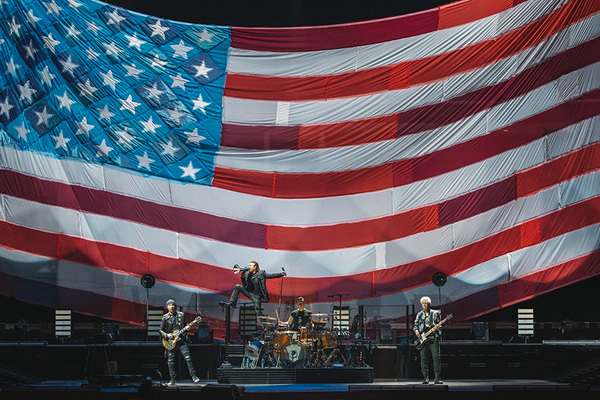
Over the last two decades, Bono has become known almost in equal measure as the frontman of U2, one of the most successful rock bands of all time, and for his humanitarian efforts. It’s for the latter that he’s set to receive the George W. Bush Medal For Distinguished Leadership.
Ahead of his trip to Dallas to receive the award, he talked with
The Dallas Morning News. The interview has been edited for length and clarity.
What does good leadership look like to you? What does it mean to be a good leader?
Off the top of my head, I've always thought you're as good as the arguments you get, really. That's probably why I'm in a band and why I'm still married. [Chuckles.] I'm not just in U2. I'm in a lot of band.
I see the
One campaign as a band. I see
(Red) as a band. I've just started this impact fund called
Rise — that's kind of a band with [co-founders Jeff Skoll and Bill McGlashan]. I just always want to be around the right arguments, I suppose, and having people who are smarter than me around. That's just what I've tried to do. And to listen. I'm a talker — sometimes I talk to try and understand subjects, but actually listening. Especially in development work, in any work, but in development work it's critical.
President [Lyndon B.] Johnson was from Texas, right?
Oh yeah, he's a big Texas guy.
Was he the one who said, “If you're talking, you're not learning?”
I'll have to look that up, but it sounds like something he would've said.
Yeah, [imitates Johnson's voice] “You're not learnin' anything if you're talking!”
I was hoping you could talk to me about your approach to activism and humanitarianism and how it's evolved over the years. I'm curious about the differences in strategy between the (Red) campaign and the One campaign.
I always saw (Red) as the sort of gateway drug to the kind of activism that the One campaign does. You know, I think it was [former Senator from Tennessee] Bill Frist ... he's a physician, and he was saying to me, if you want to make this stuff relevant to politicians, then you're going to have to bring it back to the pig roast, bring it back to the people where they live — not just the Capitol. Not just to the media. That was really where (Red) began.
We look at Bank of America and their support of (Red). It's critical in terms of their cash contributions in saving lives, but the amount of neon, of — let's call it, yeah, the neon, the amount of signage in all their branches ... You can't move without seeing the statistics about what America is doing and reminding people that it's a political imperative, using the creativity of corporate America. The creative departments of corporate America — the advertising, the marketing people, we needed particularly in the fight against HIV/AIDS, we needed everybody onboard.
Apple is our most generous contributor. Strange enough, they're most quiet in terms of the neon because they're all very modest. I'm always saying to [Apple CEO Tim Cook], please take a bow here, because we've got to half a billion dollars with (Red) and Apple deserves to take some applause. But also, we need you to make more noise, because as we're discovering, there can be some compassion fatigue.
And we've got budget cuts being pushed by this administration that would decimate not just lives, but all the work we've done. If I can remember it's over 20 million lives would be lost over the next 15 years or so. It's like getting three-quarters of the way to the moon and turning back — it's this great moonshot by America, and it is so close. I think it's the greatest single health intervention in the history of medicine, fighting a single disease and these cuts threaten to destroy it. We need heat to keep the pressure up ...
The government money is obviously doing the heavy lifting. The Global Fund and the stuff that (Red) brings in is really important, but the big numbers [are from government]. That’s why I'm coming to salute President [George W. Bush, whose administration started the President’s Emergency Plan for AIDS Relief, or PEPFAR]. Because in this, the U.S. leads the world, and he brought us there. There were a lot of people encouraging him to do it, I was one of them — it took all kinds of we sort of punk rockers and priests, we of all kinds, gathered in that movement. But he had to show leadership there. And he really did.
With proposed cuts to PEPFAR funding, there's this sense now — and getting back to what you were saying about Bill Frist — how do you bring this back to American taxpayers?
We're really grateful for the United States for the role that you play in the world, in terms of defense. But if you ask the military men and women, they will tell you that [foreign aid, like PEPFAR] is defense. I went into the Oval office to visit President Bush and I had three pills in my hand and I said, 'Paint them red, white and blue, Mr. President, because these [life-saving medications] are the best advertisements for the United States.' And he laughed.
But actually it's turned out to be true. People love President Bush all over Africa and this is a continent that will be the most powerful player. This demographic bulge will either turn out to be a dividend or a very big problem. For Europe, for the world. I think it's going to be a very great dividend. In fashion, and music and business, I really believe in Africa. But whatever you think about Africa, it is critical that we are with these new African countries that are trying to tackle corruption and put their people first. We need them to succeed.
So, development, alongside diplomacy and defense, I think, was an early Bush doctrine. Whatever you feel about the war in Iraq, [the HIV/AIDs fight] is a monumental achievement by the people of the United States. It is akin, honestly, to the heroism of Omaha Beach or the intervention in the Second World War. I think off the top of my head, it's something like 23 million lives saved through PEPFAR [and the Global Fund] — and think about that! That is a moonshot, and the only thing I'm sad about is that I don't think Americans know that they've done this. Americans are great at beating yourselves up about stuff, but actually you're really getting this right!
Unless there's a pratfall now, Congress — Republican and Democratic heroes in the House and the Senate — people like [Fort Worth Rep.] Kay Granger, there in Texas, they are not letting this administration screw this up. But I think the best way to ensure that it's not screwed up is if the American people take a bow, and say, wow, we really got this right. That’s why I'm coming to the Bush Center: I feel that I have a duty to report back on what's been achieved, a hell of a lot — a heaven of a lot.
You've obviously done a lot of development work over the last 15, 20 years in Africa and it's not a monolith, obviously, but is there one thing you've learned doing work there that you wish you could go back and tell yourself at the outset, when you were starting out with (Red)?
A Senegalese man in a meeting, he very gently introduced me to a proverb, which was: “If you want to cut a man's hair, be sure he's in the room.” And I felt, you know, gently scolded. We’ve got to watch with this. A messianic complex is a great thing for the lead singer of a rock band, but it doesn't work in development. You have to listen and listen again, you've got to learn from communities what they want.
What year do you think that was?
Probably early — like 2001, 2002, around that time. The One organization has 3 million members in Africa. I think we should've been called a Half, really up until that moment. Though we've had some brutish behavior down there from the leadership that went wrong in the South Africa office, but I'm still sure that we are right to be investing in our African leadership, and I think their voices will drown out ours pretty soon. It's up to 9 million members [total]. Hopefully we can be wind at the back of people who make courageous decisions in Congress, but also we can listen better and learn. We're mostly deployed on the continent of Africa, but I think it's a very exciting place and the best navigation is by Africans. Not by Irish singers.
I wanted to ask you specifically about working with George W. Bush. On its face, that could be an odd pairing, but your goals have sort of aligned over the years. Do you remember the first time you met him and was there anything where you sort of thought, "Huh, really did not see that coming," in interacting with him?
In terms of our bases, our relationship didn't look well on either of us. [Laughs.] I don't think he had much interest in meeting me — and why should he? You know, he'd just taken the Oval Office and he was a busy guy.
The first thing we did together was something that became known as the Millennium Challenge Corp. It was a new approach to development, it was if a country was tackling corruption and could prove the fiduciary quality of a particular investment, whether it be infrastructure, like roads or something, then the United States would invest. And it was a sort of pro-growth strategy and it was — it's not written about a lot. The Millennium Challenge Corp. — it's really innovative, and I think that other leaders are now looking at that in dealing with the problem that we're having now with un-managed migration in Europe. Leaders are seeing the need to invest in African success stories, and so this concept of partnering with people who are ready to be clear and transparent and have a really good plan and strategy, to back that — that was the first thing we did together. It was very practical.
I suppose the thing that surprised me was his sense of humor. It's not new to Texans. I wasn't expecting to belly laugh with this president. I remember riding in his motorcade with him and people were waving, and I said, "Oh, Mr. President, you're very popular, clearly," and he just goes, totally deadpan, "When I first came here, the people used to wave at me with one finger," and that made me laugh. I get it. You know, I might've been one of them.
In my teens even, I'm a protester by nature, and the undoing of my black-and-white view of things as a young man, were things like when people just didn't behave as the caricatures I had been told they were. I just had a lot of surprises. People whom I thought would be total [jerks] turned out to have a humanity and people I thought would be very inspirational let me down.
I started to be suspicious of clear political lines. I came from the left, that's where I grew up on the left, but I would consider myself, I'm interested in the radical center, which is just problem-solving. When it came to working with the world's poorest, the cartooning of people on the right as being totally unconcerned with what the Bible calls the least of these — I think we're misunderstanding the American people and we're misunderstanding conservatives. People laughed openly when we arrived on Capitol Hill to talk about a historic AIDS initiative with a Republican administration. People laughed at us — they really did — they got it wrong. And they underestimated this president.
I think that sort of pragmatism is interesting, especially in the social enterprise space, where you’re saying, hey, this is an opportunity to invest, do some good and if you're investing in infrastructure, make some money — it doesn't have to be either/or all the time.
Well, it's tricky. We’re trying to get rid of what's called tied aid, which is you buy our products and we will help, will feed your starving people. I don't think it should be so binary. I do think it's OK to see Africa — and Africans demand this — as a place to do commerce. And I can tell you that the rise of China did a hell of a lot for Europe and America in buying American products. I remember asking [German Chancellor Angela] Merkel, where would the German economy be without the rise of China?
When I'm speaking in the U.K. with people who are suspicious of development assistance and suggesting that we should take these small percentages and keep them for our own problems, I always try to remind them that this is their next door neighbor continent, and their problems will become yours if you're not careful. Also, there's an enormous opportunity here for your financial services, for your engineering, for your manufacturing sector.
We've got to stop seeing this through the old lens, which is very patronizing. You're investing in lives and those lives are important to you. They're important to America, for compassion reasons and also commercial reasons. If I'd heard myself say that in my 20s I might've thrown up, but I'll tell you who wouldn't throw up is my African friends. They see the dignity of trade as a way of making a relationship that was vertical into a horizontal one.
If I could switch it up real quickly, do you have a favorite thing to do in Dallas or in Texas more broadly?
It's funny because for a musician, you think of Austin, Texas, and I think of Willie Nelson. I think of more romantic pursuits like music, but the last time I was out with the Bushes, I went out into the landscape, and I really enjoyed that. I really enjoyed the country life. My missus would slap me around the head for saying that because she's been trying to get me to do more hiking and that kind of thing. But I would like to spend time on trails and I'd like to ride. The Joshua Tree Tour was great, and we played Dallas. That was pretty special.
I enjoyed the president's paintings when I was out there. That made an impression on me, too.
They're something else, huh?
I don't think there could be a more alchemical bond between the subjects and the paint in the hand of this painter. I found some of them quite overwhelming. I loved the attempt to portray these [veterans] as ordinary lives, with the sort of clear fact that they're actually extraordinary lives just under the surface. I liked that. Where do you think I should go? Tell me.
I like Deep Ellum. But that might be crazy on weekend nights. Fort Worth is nice, too. The president probably has better recommendations.
In Fort Worth they have a [painting by Mark] Rothko. And I know that Sean Scully, who's a sort of Anglo Irish giant in painting, I'm pretty sure he's in one of the great museums there. I've got to go to South By Southwest. I've never been, I'm embarrassed.
Jill Cowan,Jill Cowan, Economy Writer
www.dallasnews.com